A moodboard [or mood board, I’ve seen it used both ways] is a collection of images that are often used in interior and fashion design – and now have spread into many creative endeavors – as a way to build ideas and share concepts on a project. For those of us who like or need visuals to go along with our brainstorming, this is an ideal way to gather them together in a cohesive whole and see how they work together.
When I’m conceptualizing my storylines, I collect as many images as I can to help me clearly see characters, places, and concepts. I have a huge folder full of these images, broken down into subfolders, and it can be a giant pain to navigate them all! Moodboards help collect those visual thoughts into something I can glace over quickly and attain the focus I need in that moment.
They’re also a great way to share glimpses into what’s going to happen in a story, or background details about a character or concept! So I decided to share some of these with you as we get closer to the release of Cast A Shadow Of Doubt, because they might offer some context… and it will definitely be fun!
I love playing with tools like Picrew to make character mockups, like this attempt at showing Lucee ☺️ Do you know how difficult it is to find a set of skins that both offers the option for Black hairstyles AND green hair? Near impossible!
The images in this Moodboard include: an image that made me think of the Ar Donnath, a Summer festival, a concept for a new character [Emmaline], an exciting concert image, some magical yet creepy looking fungi, a community garden, an attempt to visualize one of The Ladies. What does it all mean? You will find out soon!
Want to stay in the loop about when Cast A Shadow Of Doubt will be released, and where you’ll be able to buy it? Sign up for my newsletter or support me over on Ko-fi! [btw, Ko-fi supporters have more access, see things before anyone else, and get exclusive content!]
One of the questions I get asked a lot, and I’m sure most writers do as well, is one that cuts to the bone of our motivations.
What made you want to become a writer?
It is a well-meaning question, asked by those who truly don’t understand that writing is less of a choice than a drive or a need, at least for me. I’ve been writing stories since I learned how to print my letters. Stories have been in my blood from the very beginning. I learned to read when I was two years old, and I was writing before I started school. I’ve mentioned before that in first and second grade I had a following of girls who would join me in the grassy field during recess while I told them tales that I created on the spot. We would make clover chains and discuss faeries and talking animals and creating magic potions. There’s a meme out there about how little girls instinctively form covens and I’m here to tell you that, at least for me, that was so true.
I wrote my first book at age six, and it was a total rip-off of E.B. White’s The Trumpet of the Swan – okay, okay, it was inspired by it. I even illustrated it, and made it into a stapled chapbook, foreshadowing of my ‘zine days to come. I loved every bit of doing this, and from that moment on, I was hooked on being a writer.
To me, it made sense. I was a voracious reader. I told myself stories all the time. Why wouldn’t I be writing books?
I had a lot of stops and starts on my path of sharing my words. I wrote poetry, music, short stories. I published them myself in my ‘zines, and had them published in other ‘zines and small press publications. I blogged online, fairly religiously. I wrote in my personal journal daily, and some of the things I crafted there became shared pieces.
And I started abortive attempts at novel writing. None were successful, at least not for a very long time.
I like to keep the magic alive outside of the book, too. This is what came in the original deluxe signed paperback packages.
It wasn’t until I revisited my notes for the world of the Eleriannan, as I looked for inspiration during the pandemic lockdown, that I started to see how the stories I’d begun and then abandoned could be fleshed out. They’d been waiting for me to get to the right place in my mind and in my life.
Everything is terrible! Let’s write a book!
Now that I’m into the editing portion of Cast A Shadow Of Doubt, I have time to read for pleasure. That’s a good thing, because I have a BIG stack of TBRs, and the one on the top of the stack is Never Say You Can’t Survive, by Charlie Jane Anders.
I’ve been dying to read this, and so far it has not disappointed. The subtitle is How To Get Through Hard Times By Making Up Stories, and if that isn’t directed straight to my heart, I don’t know what is. Chapter five in particular has hit home for me, because it talks about writing the things that comfort you when the world is burning. One sentence in particular jumped out at me and brought tears to my eyes.
“Write whatever you need to survive.” – Charlie Jane Anders
Her point is that we get a lot of messages about what we are “supposed” to be writing. Some of those are external, others internally designed to make us feel like we’re not good enough as writers. [yay for that, brains] However, our actual job as writers is to bring forth what we need in the world. And not what we think everyone needs – no, I should write what I specifically need or want. You should do the same. Write the thing that gives you heart to go on, that allows you to get up in the morning, that fills a space in your life that was lacking before you addressed it with your words.
YES PLEASE.
THAT is when writing brings joy, when it rings out clearly across the empty spaces that needed those words, those ideas, that specific story. Writers who embrace this philosophy are easy to spot, at least to me. Reading their stories is an authentic experience.
Conversation between me and Christopher, which is when it all became clear to me about why I write.
And that is why I was able to write In Sleep You Know, when before I’d never been able to finish writing a novel. It was something I needed, a moment where possibilities exist and magic is real but what really matters are the choices that one makes… Especially the choices that bring friends together and create family and community.
And Cast A Shadow Of Doubt embraces those values even more. I cannot wait to share it with you, because these stories are what I need to see in the world, and I am hoping that they are for you, as well.
I know I write a bit about the importance of the soundtracks for my books, but there’s a reason for that. Poetry – the lyrics that shape the direction of the feelings being evoked by the instruments and tune that they ride on – makes or breaks a song for me. And when used well in an accompanying soundtrack, those lyrics can develop undercurrents of meaning and energy, and even deliver secrets about the characters or plot.
I’ve spoken about how I carefully match each song to the chapter it heads, and I’ve even mentioned that certain songs remind me of specific characters – basically, their theme songs. But I also pick songs for lyrical content that reflects what’s happening in that chapter, or in some cases, what’s happening concurrently in the plot but isn’t the main focus at the time. It’s one of my favorite ways to add layers to to the tale.
But the reason I wanted to talk about music, specifically lyrics, is because I was listening to one of the songs I’ve included on the soundtrack to the upcoming sequel to In Sleep You Know [title announcement coming SOON], and the poetic imagery of a few lines in Queen Of My Heart, by New Model Army, was so evocative that it brought tears to my eyes.
When Justin begins describing the sky, and how he can feel the dark and how cities and deserts are the same, I always find myself holding my breath, tears building behind my eyes. It’s such a strong, meaningful bit of imagery, a scene painted out in an economy of words that somehow never fails to put me right in that moment.
My personal understanding and meanings behind the song changed recently when it became a song that represents how one of my characters, Sousa, relates to Vali and his relationship with her. That deepened the resonance of the lyrics, which were already heavy with personal feelings for me.
Before I was writing novels, I was a poet. To build a series of emotional responses from a carefully crafted stack of words and concepts, each creating a connection of thoughts that paint a picture or represent a feeling or concept is a heart-skill. Poems look easy to those who do not write them, and poetry crafted into meaningful lyrics even more so. Lyrics require a deft hand and the ability to transmit a sentiment or trigger a response with less words, carefully entwined with the music in a way that increases the emotional punch. Lyrics removed from music often look simple or trite, because removing them from their scaffolding weakens their effect.
As someone who uses lyrics in my novels, that presents an interesting challenge. I write my own lyrics. They do have music that goes with them, but not transcribed or recorded, and at this juncture I’m not interested on taking that task on. So when I write about The Drawback performing and I include lyrics, I risk them coming off as overly simple – bad poetry. But they are missing that aforementioned scaffolding, so my job as a writer is to describe what sounds and sentiments are supposed to be there as support, so that the reader can imagine them in their mind. If I’ve done my job well, the reader should get an immersive mental experience bolstered by their imagination and the imagery I’ve conjured up.
My old band, The Violet Dawning, proof that I do actually know what I’m talking about when I write about music 😉
It’s always a risk that it won’t work. But when it does, you – the reader – will feel that music, even though there’s none to be heard, and the emotional content of the lyrics will have the proper punch.
When you put on your favorite music that has lyrics, how does it make you feel? What effects you the most in the track, and why do you come back to that track time and again? What song would you insist must be on your personal soundtrack, and why?
Now take those questions and apply them to your favorite stories and characters, and see what you come up with. It is such a fun exercise, and it can give you interesting insight into characters and parts of the storyline you might have never paid attention to before! I’d love if you shared some of those pairings in the comments, here or on Facebook. Go forth and listen with a new focus!
I’m pleased to announce that there are two different ways to support my work – and get lots of extras!
I’ve been using Ko-fi for a while now as a place where readers, fans, and friends can pick up a signed copy of In Sleep You Know & related merch, as well as support me and my writing through donations, AKA “buying me a coffee.” It’s a great platform, where I actually receive all of the funds donated outside of Paypal’s cut. But until recently, I couldn’t differentiate between updates for fans and knowledge that other writers might have an interest in following.
Ko-fi has changed this, and I’m happy to announce that I’ve created membership tiers for my regular supporters, including one for current and/or aspiring writers!
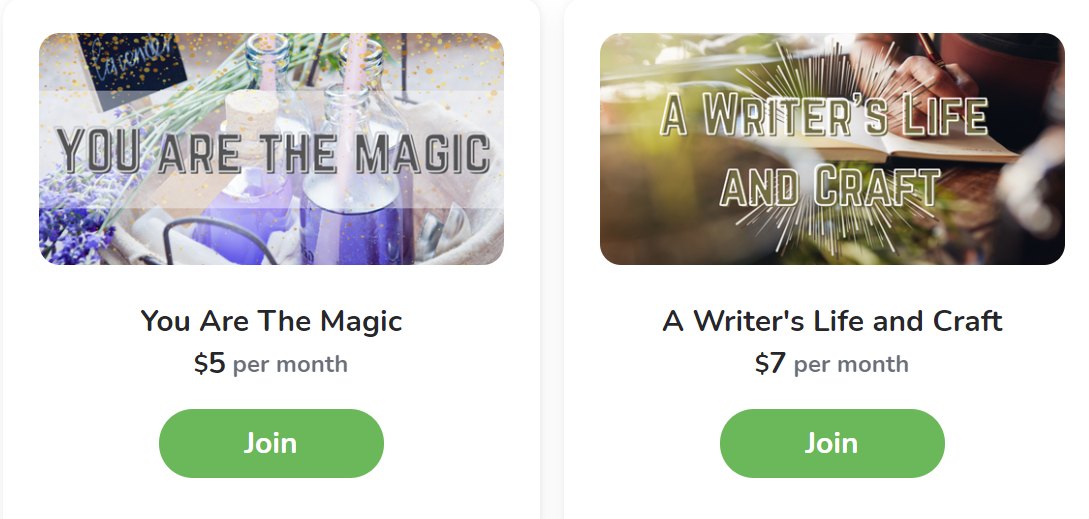
What does this mean? Well, if you are only interested in getting those current work snippets, exclusive poems/short stories/preview pages, and other behind the scenes updates, then the first membership tier – YOU are the Magic – is for you. Basically, if you’re a fan, you’ll get access to all kinds of exclusive content, all for five bucks a month. And if you’d like to contribute more [thank you] then I’ll create tiers for that as well. Just let me know.
If you are a writer or aspiring writer who is looking for tips about writing, as well as backstage access to the process of what the self-publishing process is like and how I manage being a publishing author, A Writer’s Life and Craft is your membership tier! Some of the topics I’ll cover include finding your voice and style, being authentic as a writer, refining your craft… and also things like how I decided to self-publish instead of going the Trad route, what kind of help I’ve enlisted along the way, what tools I recommend, the struggle to get seen, and much more.
Along with access to all the posts in the first tier, you’ll get an extremely honest glimpse into my life and processes as an author. I’ll be open to questions as well, which is pretty great access for only seven bucks a month.
Supporting my work in this way is just one way to ensure that I keep your bookshelf or e-reader filled with stories about the Eleriannan and their friends Merrick and Lucee. It also allows me to plan for future events like book signings and convention appearances.
To learn more and sign up for membership, click the cute button below!
I have been working hard on the sequel to In Sleep You Know, and the manuscript has reached 27,000 words. Of course, that doesn’t count the outline and copious notes I’ve also got, because are you even writing if you don’t have twenty-seven pages of notes and outlines? [I am only exaggerating a little, I love amassing notes on my projects]
This Trello board contains a ton of the behind the scenes work that went into keeping In Sleep You Know organized
As a writer, it is important for me to stay organized, and to be accountable to myself and my readers. I am self-published, so I don’t have publisher deadlines to keep me on track. Technically, I can do whatever I want, whenever I like. That’s fantastic for my mental state, because I abhor the idea of having to answer to someone “above” me – hence why I have worked for myself for so long. Freedom is important, but I still require structure in order to be effective at what I do, and setting my own deadlines helps to keep me focused. Producing within a reasonable amount of time keeps readers happy, as well!
One of the ways that I create structure is by setting word count goals as I write my manuscript. Those turn into editing goals once the first draft is complete. For In Sleep You Know, I used NaNoWriMo [National Novel Writing Month] to motivate myself to keep on track with word count and production. For those who are unfamiliar, you join a community that is aligned to one purpose: writing 50,000 words in the month of November. There are trackers on your page where you can update your daily word count, and the page creates a graph that shows you your progress. It’s a great visual reminder, and for a rewards-driven person like me, it gamifies things just enough by awarding writers various cute virtual badges on your user page.
NaNo was the push I needed to get inspired, and I finished the first manuscript for ISYK in record time. It was a real breakthrough for me as a writer! This time around, I am using a variety of cobbled together resources to keep me focused and motivated, including my Facebook group for writers, online writing sprints with Caveday and via the Clarion West Write-A-Thon, and using the daily word count goal option in Scrivener.
I invested in Scrivener towards the end of working on In Sleep You Know, and it was one of the best purchases I’ve made for my writing career. Highly recommended!
Scrivener and Trello are the backbone of my process. I also use Evernote to take notes on the fly, which get automagically uploaded to Trello. I tend to dump a lot of the research that I do [names, lore, lyrics, concepts] into Evernote as I gather it. Once it gets uploaded to Trello – I use Zapier for that – I can sort it into the proper cards.
Trello holds everything from my outlines to character sheets to the piddly but important details like “what was everything in Merrick’s pouch?” and “What does each House look like?” I can add photos, links, and even task lists of every point I want to hit in a character’s arc, for example. As I am a very visual person, I find it to be really helpful in this regard!
Scrivener does have a lot of the same functionality, but I prefer to use it for words over images. The current project – “Unnamed Sequel With Working Title: The Immutable Truth” which I know just trips lightly off the tongue – is mostly chapter folders with scenes broken down in each chapter, plus some notes with character goals and motivations, a rough outline, and a few character sheets. Nothing fancy, but wow does it work for me!
Previously, I used Google Docs, then another writing program that was free, and messed up my manuscript when it was time to save it. You get what you pay for, folks.
You might see a few clues for what’s to come in the new book if you look carefully at my Scrivener screenshot, la la la. You’ll note that some chapters already have their band and track assigned to them, and others have not. That’s a laborious process that, I won’t lie, I love doing so much. I have an entire playlist already going for the book with songs that fit the mood and the plot, with more to come. Others probably won’t make the final cut, but they are still definitely mood and might end up in an extended mix at some point. Want a sneak peek at what’s on there beyond what I’ve captured in that screenshot? Supporters on Ko-Fi have the link! [hint hint!]
I will be compiling a list with ALL the links to tools, books, and other helpful things that I use and recommend as an author – if that is of interest to you, comment below!
[Some of these links are affiliate links. What that means is that I am referring you because I like and use this item, and I’ll get a little bit of cash for recommending it, which supports me and my work. Everyone wins!]
They say that good things come to those who wait, and I am taking that advice to heart as I get through the final processes of getting In Sleep You Know ready for its big debut! The chances are good that you don’t really know what it entails to get a novel from idea to manuscript to proof to book. Add in all the various forms in which one can release a story – hardback, paperback, epub/mobi, audiobook – and the work really starts to stack up. And if you aren’t versed in this, it can feel like a daunting task… especially if all you really wanted to do was write stories for people to read.
I’ve found that I already had some of the “extra” skills that one needs to publish a book independently, which gave me a good start. I am used to creating my own graphics, marketing copy, and press, thanks to my other job as a fiber artist at Three Ravens Studio. I can also take passable photos, thanks to years of shooting my yarn and fibers. That’s definitely more than a lot of writers have in their skill sets when starting out.
The key to success, in my mind, is getting an understanding of what I don’t know, and then either learning how, or hiring someone skilled in those areas to be on my team. In this case, I am both taking my time to learn more about formatting and proper setup/layout for printing and publishing, and I hired a fantastic designer and book coach to help me through the process. I can’t say enough good things about Leesa Ellis of 3 Ferns Book Design and all the work she’s done to make In Sleep You Know go from a weirdly formatted .doc* to [almost!] finished book. If you are an aspiring author looking to self-publish, do yourself a favor and invest in hiring someone like Leesa to help you though these steps. You need editors, advisors, designers, and other professionals on your team. It’s important that these people are not you! Getting that outside input is vital. Trust me when I tell you: you are too close to your work. You need a team. Even if that team is Beta readers and trusted friends – though don’t rely on them to do your heavy lifting. You truly do get what you pay for. *I add a lot of extra paragraph breaks and spacing when I write, because it can be difficult for me to differentiate dialogue, etc in my working manuscript otherwise. Finding all those things to fix them later is a pain and my editing team are saints.
When I get stuck, creatively, I often go to the Sovereign Oracle and expansion packs for a kickstart. It never fails to apply to the situation!
In the coming weeks, I’ll talk more about the tools I use, what I’ve been doing during the pre-launch-countdown time to prepare, and of course I’ll be sharing some more short works. By the way! I am writing a short story that goes along with In Sleep You Know and will be offered for FREE to those who join my mailing list! It won’t give away the story, but you will learn more about one of the characters and get a feel for the world of the Eleriannan before In Sleep You Know hits the shelves. Want in? Just sign up for the Mailing List and as soon as it is ready, you’ll get it in your inbox!
So here I am, talking to you like we’ve just run into each other in the halls at a con, or waiting in line to get into a show, or wherever you might see me and feel bored enough to ask a bunch of questions about who I am and what makes me the person I am. Why? [Why not!]
I’ve got a Bio page, but that’s just got the “writer” stuff on it, and I’m a big believer in connection as a full contact sport. No, not like football, more like jumping into the pit at a punk show.
So that’s a great place to start, actually – I DO NOT do sports. I always say: if you see me running, then you should run, too, because something is definitely chasing me! However, I not only love dancing with every fiber of my being, I actually minored in Dance in college. [Theater major, because I am obviously into things just for the money, right?] I’ve talked at length about how I got into being involved with the Goth/Industrial/Electronica subgenres and built myself a small career as a DJ and promoter for a while that way, so I won’t go through the whole story now. But you need to know that my direct progression involved music and dance in school > discovering the joy of going to punk shows and the freedom of everything it brought > finding alternative dance nights at clubs that gave me the confidence to really pursue the things that give me joy.
I’ve always loved writing, music, and performance. For someone who spent a great deal of time in her own head while growing up, I managed to still excel at being dramatic – to the point where I knew that I wanted a public-facing job when I grew up. I played at being a radio DJ, introducing the 45s I’d play for myself as I recorded my own mixtapes, learning bits of trivia about the bands I liked to “reveal” to the audience. I also made my own dramas and musicals, did my own costuming, and wrote my own scripts, all to be performed by and for myself in my room. [I liked sheets for sweeping togas, capes, and skirts.] And I dreamed about fronting a band, and probably shook the house at inappropriate hours while practicing my vocal stylings. Come to think of it, I still do.
So falling into Theater was obvious, and I pursued that and music and dance, and found myself more and more frustrated as I ran against what I was expected to be, rather than what I am.
Punk was the antidote.
When I discovered punk, I learned that there was a world where it was a lot easier to be who and what I wanted to be. There was still pushback to some degree and plenty of -isms, but the culture was set up in a way that gave me more freedom to speak out against them, and show anger in general. In the 80s, it was still tough to be an angry woman, an individual, a rule-breaker, and not be penalized in every aspect of life. Punk mostly didn’t care. I thrived in that scene, and I grew comfortable in my own skin.
Posing with my beloved friend Faron, 1987ish? Fully feeling myself here.
That led me to finding more Post-Punk and Alternative music and going to clubs that played those genres, too. Suddenly, I was at a show or a club every week, absorbing even more music and being exposed to a wide variety of culture and art, and I loved it all. My outfits got more dramatic, slowly verging into a decidedly Goth aesthetic, which then blended with my everyday look forever. Seriously, I’m still basically wearing the same stuff, just the more casual versions. Long black skirt and band tee, with a hoodie or cardigan and Docs? Yep, that’s me.
And that phase, my friends, shaped everything else in my life. I found the people who appreciated my aesthetic, my words, and eventually the music I wanted to make. I started publishing ‘zines and contributing to others, and I became a small time club DJ around the East Coast of the US, centered in VA/DC/MD.
A lot of In Sleep You Know is fueled by these experiences. It references clubs I went to regularly, music I love, and the subcultures of which I’m a part. It also reflects the wonder I felt when I started coming to the city and discovered a place where I belonged, and all the magic and weirdness I learned to see and accept without question. Merrick Moore, the main character, is in many ways who I was when I first roosted in Baltimore City: a aimless dreamer accepting of the beautiful and odd people randomly met along the way. Someone game to roll with strange happenings, because deep in our heart, that was we always hoped to find.
Me and Merrick, we’re the dreamers here.
In the harshness of daylight, we might have a harder time buying into the weirdness than we did under cover of night. But those experiences changed me, shaped and reinforced my sense of whimsy and wonder and possibility, and gave me a lot of fodder for the things I write about now! And now you get to see how they shape Merrick, too. *
If you like reading true tales of my strange adventures that are 100% unvarnished and often ridiculous, let me know. I have so many shareable snippets! Not everything is going to make it into my books, right?
* NotASpoiler: it’s a bit different than how things went down for me. ps: Post Title is a snippet of song lyric from “Baby Doll” by Ruin, a Philly punk band that meant a lot to me back in the day. pps: I updated this post a tiny bit in 2026 but only to reflect that ISYK is out
Receiving advice and criticism isn’t easy. I like to say you need a Teflon-coated ego if you’re going to put yourself out there in any creative field. And if you’re a sensitive soul [like me, I fully admit it] that can be difficult to achieve. How do you get there?
“Knowing Who You Are” is the key to everything: that’s how I interpret and take in the advice and criticisms given to me in a way that doesn’t break me, and that allows me to actually glean the important, useful parts.
Being able to gracefully take advice and criticism is one of the most important skills that any creative person can possess. As someone who finds herself in creative roles that have thrust me into the public eye over and over, being able to roll with the punches when it comes to how people receive my work has always been a battle, but one worth waging. You just can’t get up in front of people, on *any* platform, and put yourself out there without expecting razzes with the praise. It’s what some people just do. In fact, I recommend preparing yourself for the possibility that the jeers will outweigh the good words! I firmly believe in the idea that it’s easier to be prepared for disappointment with the hope to be pleasantly surprised, than the opposite. Not everyone is going to like or appreciate your work. That doesn’t mean your work is bad!
The trick is to be able to separate valid criticisms from a general “this is not my jam” reaction. Same goes for advice, especially advice that goes against your instincts or raises a pushback reaction. That’s when it’s important to sit with those words for a while, and really take some time to reflect on why they are triggering that response in you.
I’m going to use myself as an example here, because that’s how I roll, and I have no problem sharing my vulnerability and ego weak points. [please do laugh here!]
I threw a piece of writing out there recently to get some editing advice. I read the suggestions returned to me and my heart sank. The editor I was most interested in took my writing and ripped it apart.
Except… they really didn’t. They ripped into it, sure – but not to destroy it, rather in order to point out all the places where mercilessly editing it would tighten it up and make it a better read overall. Was it brutal? Sure, to my ego, for about five minutes. Then I got over myself and paid attention to what was being suggested. Some things I didn’t agree with, but I earmarked them to revisit in a bit while they tumbled around in my head. Other things were “duh” revelations, like a continuity problem here or there, or an overlooked grammar mistake.
After I sat awhile with those suggestions that I didn’t agree with, I went back and re-read with the edits in mind, and with a sincere effort to read the story like it hadn’t been living in my head for a while. Did I end up using all the suggestions? No, I did not – but I did use some of them, and the whole experience caused me to go back and look over the rest of my story again with fresh eyes, and make changes in other places. I came away feeling that my writing was improved, but still felt like mine. It’s still not perfect, and I don’t think I’ll ever be the writer who is 100% satisfied with her work, but that gives me glorious room for improvement, yes?
That’s what I mean when I say “know who you are.” I know what I want in my work. I am pretty confident in knowing my strengths and weaknesses – and I’m also aware that I have both of those that I might not see because I’m too close to the material. That doesn’t make me a bad writer [musician, artist, whatever] – it makes me a human one. I know who I am, what I want out of my work, and what I’m capable of; knowing that gives me the space to allow others to offer words that can help me improve. And knowing who I am also gives me the strength to reject or ignore the criticisms that aren’t designed to be helpful.
Does it always work? Hell no! But keeping grounded in that knowledge can help me weather the worst and keep growing. And that helps me to improve my craft, as well. Win-win.