In Sleep You Know

22 posts

Story Order: How to Read Stories of the Eleriannan

“Dear Christiane, 

You have multiple books/stories in your Eleriannan series! It’s not clear to me how this works; can you help?”

You bet I can!

Let me break it down for you, with lots of details about what each story is and where it falls in the timeline.

First thing you need to know is that all the stories can be read independently from each other. There are no cliffhangers, but reading them out of order will reveal some plot points from previous stories, so be aware. I’ve tried very hard to make sure that you won’t feel lost if you read them out of publication or chronological order.

As of October 2025 are currently these titles:

  • Escaping the Dreamland [#.5]
    • Events happen well before ISYK
    • Tells the story of how Aisling came to be, 1st person
    • Short story
    • Available with subscription to my mailing list
  • In Sleep You Know, A Story of the Eleriannan [#1]
    • First in the series
    • Introduces you to many of the characters
    • Told mostly following Merrick, 3rd person
    • Draws inspiration from various Faerie mythologies and folklore as well as Child Ballads
    • Novel length, stands alone
    • Set in a, um, slightly different version of Baltimore
    • Soundtrack
  • Cast a Shadow of Doubt, Stories of the Eleriannan [#2]
    • Second in series
    • Tells the stories of Lucee’s rise to leadership and Camlin’s attempt at redemption
    • Introduces the Mealladhan and Emmaline
    • 3rd person, mostly following Lucee
    • Features more Baltimore culture, including big summer art festivals
    • Novel length, stands alone but is even better paired with ISYK
    • Soundtrack
  • A Third Kind of Madness, A Story of the Eleriannan [#3]
    • Third in series
    • Introduces Denny and Peri as well as Denny’s art collective, the Ants, and new Elementals
    • 1st person, told through Denny
    • If you’re a fan of Karsten, they are a prominent character
    • Art scene, farmers markets, and the Mount Vernon neighborhood are featured
    • Novel length, stands alone
    • Soundtrack

Coming in 2026:

  • Eleriannan #4 [as yet untitled]
    • Fourth in series
    • Centers on Emmaline and her struggle to integrate into The Grimshaw while discovering the depths of her powers
    • Introduces some new Grimshaw characters, especially some of the Arswyd and Ettir, an Eoten
    • 3rd person, mostly following Emmaline
    • Want to find out why the ArDonnath are so nasty? Here’s your chance!
    • Novel length
    • Soundtrack

If you have further questions about any of the Eleriannan books, you can always ask here! Also check out the Fae Directory and my series The Magic Between Us for more insight about the characters and how they interact with each other. 


I should probably mention that I have an unrelated book that is also set in Baltimore coming out in 2026. It’s a speculative fiction near-future story called A Small Light in the Darkness, and it focuses on two characters: 

  • Tryst, a lonely and longing poetic soul who can’t seem to make a “true” connection with someone who can satisfy her longing for something deeper
  • Fo, mysterious and thoughtful with a multitude of secrets and a deep need to connect even though they are scared of the emotions that brings

Together, they unravel the unknown aspects of Fo’s past, revealing a terrible accident with an experiment gone wrong, the drawbacks of mind enhancement, and a secret that goes much deeper and darker than either of them had imagined at the start. 

Recommended if you like stories about transhumanism, and/or with human-computer interaction, romantic subplots, connecting with strangers, poetic prose, science gone bad.

A Map of the Eleriannan

Have you wondered where in Baltimore that one scene took place? You know, the fight scene at ArtPark or where Denny met Dorcha or that club where The Drawback played their first show?

Wonder no more! Here is a map that will show you all those locations and more! Please keep in mind that because the Baltimore where the Eleriannan and Gwyliannan live is laid over the one most of us live in, you may see something very different on this map than what is actually there for Merrick. Luccee, Denny and friends.

If you click through to the page where the map is hosted you’ll see a clickable navigation list. You can also access it here through the icon at the top left. If there’s a location I haven’t added yet that you want to see, just let me know.

I hope you enjoy this exploration of both mundane and magical Baltimore!


Writing the [Mostly] Real World

One of the things I always mention about my stories is that they’re set in Baltimore, MD, USA. I was born, raised, and lived a chunk of my life in Baltimore. It’s a vibrant and delightfully weird city, oft-maligned; it definitely has problems but also has some great people and energy. It’s been struggling to find it’s footing for a while and has slowly been shifting in personality – yes, cities have personalities – and growth is rarely easy, which can make the more skeptical folks think everything’s a mess, when really, it’s change happening. All of these things make for a compelling backdrop and character to use in my stories!

Also, even though I know the city well, writing about it has allowed me to learn even more beyond what I’ve known and experienced about Charm City, especially since it has changed a lot in my lifetime. I can’t just count on memories to fill out a scene, I either have to double check myself against what’s the truth now, or make a conscious choice to warp reality a little to fit my vision.

So now that I’ve said that…

If you’re from these parts, you might have guessed or recognized some of the locations I haven’t outright mentioned in the books. I name the neighborhood of Hampden, where Lucee and Cullen have a lovely date and then get into some trouble, and that’s pretty much exactly as it is currently in the non-book world. The Round Falls area also is the same, and that bit is actually based on a true experience I had there. The community garden that Vali does a mural for doesn’t exist outside the books, but that neighborhood around Greenmount Cemetery is pretty accurate otherwise. The thoughts that Vali mentions about changes in the neighborhood, positive and negative, are valid. Wyman Park Dell is more or less the same in both versions of Baltimore. I describe the building known as The Belvedere as characters pass by it, and I talk about Mount Vernon Place in great detail as it’s a big part of the setting in A Third Kind of Madness.

Writing about the farmers market under the JFX was one of my favorite parts in ATKOM, by the way. I’ve had people ask me if that’s a real market, and how could it be held under an expressway? Folks, it’s real, it is awesome, and you should definitely visit it if you’re in town. I actually used to vend there, selling my handspun yarn and handmade products!

And then there are places I invented completely, like the Frisky Bean. The Bean gets it’s believable feel from my deep experience with that kind of coffee house, but sadly there isn’t a place I can point out in the Mount Vernon neighborhood that matches that vibe. House Mirabilis and Tiennan House don’t have specific inspirations, but Baltimore has plenty of old houses that could stand in. The Compound has an address [sort of, I don’t really obscure where it’s located] and if you look it up using online maps, you can get a visual for the outside, at least. The interior layout, I based on judging from the outside and using my experiences from being inside similar buildings, with my own whimsical additions of course.

Some spots what I’d call book-analogues to actual places that exist, but under different names. Club Marcada on Charles Street is an amalgam of a couple of different clubs I’ve known, but it’s absolutely set in the same block as Club Charles and The Depot. [And The Depot certainly gets some quiet references in the description of Marcada, IYKYK] The Maithe also could be put in this category, but I think it needs it’s own, for reasons I’ll explain below.

The Maithe is special [duh]

First off, let’s discuss the one very specific thing I changed about my version of Baltimore: Park Street.

There is no Park Street in Mount Vernon.

There is a Park Avenue, and yes, I know someone from here might read the books and think “Oh, Xi doesn’t know what they’re talking about, they messed that up.” Nope, sorry, that was a deliberate choice that will mean nothing to people not from Baltimore but to locals [and me] it signals that we are stepping outside of the “real” world and into a different version of the city. Basically that entire street, which happens to house the Frisky Bean, Denny’s studio, and The Maithe, is a magical corridor that lies just slightly off from the world we move in. So if you’re in Mount Vernon and you happen to be walking down Park Avenue, you’re just a sidestep away from where so much of the story takes place!

How do you shift over to Park Street instead? Well that is a good question… isn’t it? 😉

Trivia point: my very first apartment, of which I have no end of ridiculous tales, was on Park Ave. in Mount Vernon. Living there and observing a lot of the odd, amusing things that happened regularly was part of the inspiration for setting the story in that area.

That “slightly off” mirror world, the Baltimore that could be if we sidestepped through the veil unexpectedly? That’s where you can walk from the Bean and spy magical graffiti in an alleyway before you come to the end of the street and the great building that dominates it: The Maithe. Yes, The Maithe is inspired by a building I know, The Brexton, now known as a hotel. No, it’s not the same in this world…as far as I know. It doesn’t house a great, seemingly unending forest in its center courtyard. Indeed, there’s no courtyard at all, though in my opinion there should be! But the staircase? That’s there, and the triangular shape, and the towers on each end. I think The Maithe probably deserves its own post, because I have personal anecdotes I could share as well as a lot of background about how I envisioned the layout inside, which is quite different than the building it’s based on. And as time’s gone on, The Maithe has revealed secrets about itself and those are fun to talk about, too.

I keep promising a video tour of the Eleriannan’s version of Baltimore, and I promise it’s coming soon! The weather’s been too hot and unsettled for your pal Christiane, but as soon as I’m feeling up to it, you’ll have it. Part of the joy of writing these stories is sharing my city with you through my eyes and imagination, and can’t wait for you to see the places that inspire me.

More to come, including in-depth details about The Maithe!

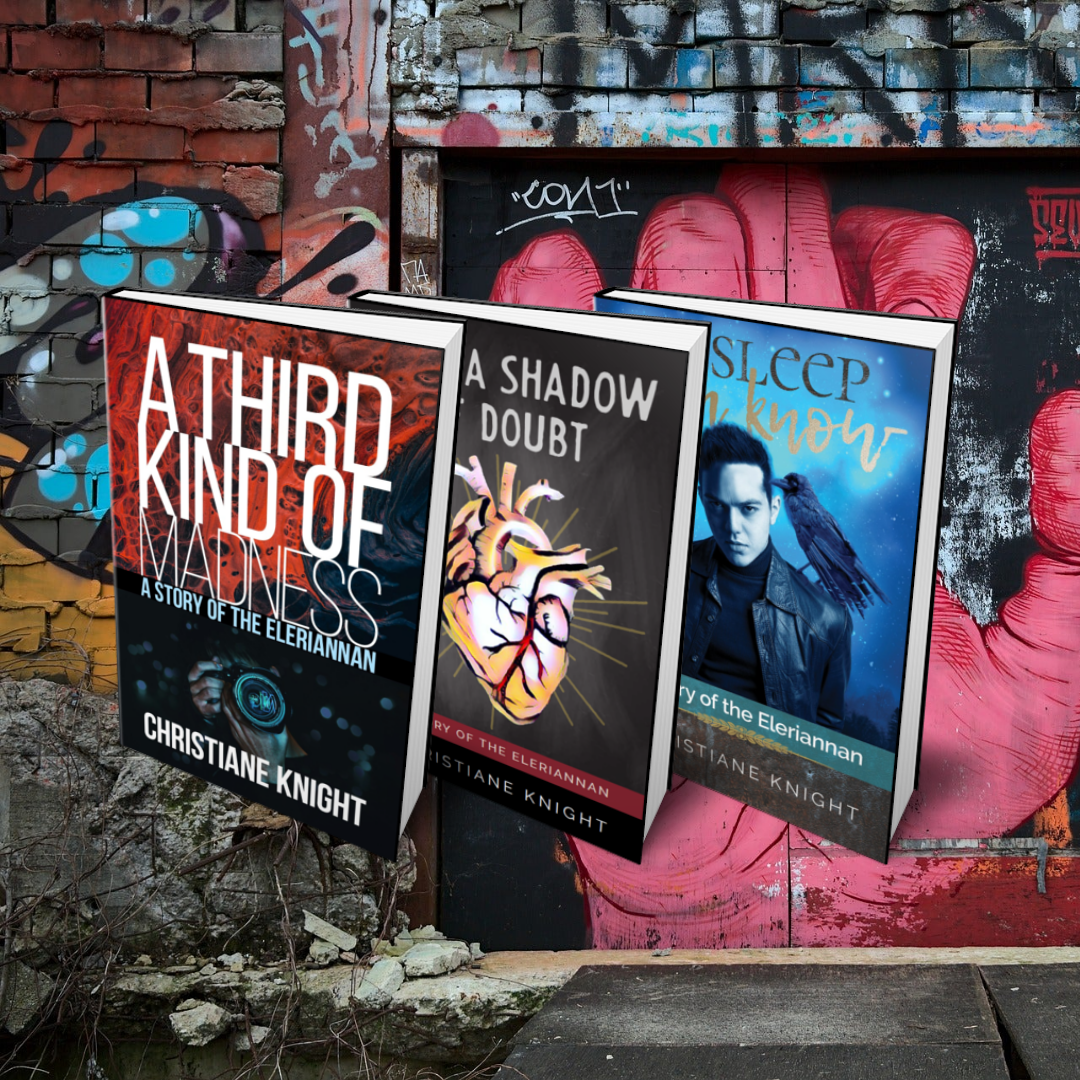
Three book covers against a graffiti backdrop

Seven Things About What I Write

For no reason except that I like to talk about my characters, settings, and themes, I’ve put together this [hardly exhaustive] list of things you can find in my stories.

Look, it’s a list!

  1. My stories center around Baltimore.
    Why? Because I’m from here. The city and its surroundings are a place filled with beauty and quirkiness that are often ignored in favor of focusing on the darker aspects, ones that get a disproportionate amount of screen time on TV shows and in movies. Those things are there, but it’s not all there is to Baltimore by far, and part of my goal is to rebalance things by telling hopeful stories set in a place that deserves them. Also, B’more has so many hidden treasures and interesting people. It’s the perfect place for a community of Fae to live without much notice.
    Most of the places I mention in my books are real places, or based on real ones. I’m planning a video tour of Fae Baltimore at some point soon!
  2. My stories are hopeful. As I mentioned above, I write books where the characters – no matter what they’ve been through – tend to work toward positive change and helping each other. There’s room for forgiveness and transformation here, something that reflects my own stance on life but also serves as an option for folks who are tired of the preponderance of grim, heavy stories out there and want something that encourages them to look at the world with fresh eyes. I don’t shy away from tough and painful topics, but I address them with small, positive steps that anyone – not just magic wielders – can take.
    It’s important for me to allow room for things like the possibility of redemption and the importance of community in these stories.
  3. My Fae characters are not inexplicable or confounding. In a lot of Faerie lore, the Fae are unpredictable, impossible to understand, without rhyme or reason to us mere mortals. In my stories, that’s not the case, or at least, not exactly the case,
    The closer that the Eleriannan and Gwyliannan live to mortals, the more they seem to be like us, with concerns and motivations that mortals can comprehend. The ones that are more difficult to parse are the older ones who have begun to separate themselves from the mortal world. And of course, there are beings like the Elementals, which not even the Fae can claim to understand.
    But one of the parts I love the most about writing my Fae is that despite being magical creatures who have lived well beyond the life span of the mortals they associate with now, they still struggle with emotions and relationships and maneuvering through the world around them. The magic they have solves some problems and creates others. They make plenty of mistakes, and also beneficial decisions. They are knowable – and loveable – because despite not being like us, they really are like us in all the ways that count.
  4. My characters care about taking care of the people and environment around them. There are plenty of social and environmental issues that are important to Baltimore that the characters address on a regular basis. Homelessness, racism, gentrification, pollution, poverty, environmental responsibility, justice, healthcare, class, and inequality are just some of the topics that characters touch on.
    They model helpful actions, too – especially Vali, an activist who puts her energy into using her magic to protect community projects and organizing cleanup sessions at the local waterways. The Gwyliannan contribute to their area by magically protecting the neighborhood from crime and other intrusions.
    I want to leave readers feeling like they can do more if they want and there’s a place for them out there with others who work towards positive goals.
  5. I like to refer to Faerie tropes and give quiet shout-outs to stories that came before mine. I bury references to all the lore, ballads, poems, and classic literature about the Fae that I grew up with, as well as nods to works by more contemporary authors that I’ve loved, throughout my stories. Sometimes it’s very subtle, other times quite overt if you’re familiar. It’s both a tribute and a way of connecting my tales to the bigger collection of lore out there. Also, it’s fun!
  6. I make up my own creatures and lore. Eleriannan, Gwyliannan, and Grimshaw. The Lady of the City. The Nyxen, Ffyn, Arswyd, ArDonnath. Those all came from my own head, though of course with plenty of precedent from the classics mentioned previously. I feel like a thread of truth runs through every interpretation of various magical beings and creatures, and mine are just one version of things that can feel both unique and familiar all at once.
  7. My characters are a little too real! I’ve been told time and again that they feel like people that my readers know and love like old friends. And to be truthful, they feel like that to me, too, even the new ones that show up unbidden to take over my stories. [I’m looking at you, Denny.]
    I’m often asked if they’re modeled after people I know and the answer is both yes and no. Certain people definitely had some influence over the beginnings of some of the folks in my stories, but once I started writing them they began to get minds and wills of their own and often will surprise me with some of the choices and directions they take.
    It’s quite delightful.
    Because of that, they get deeper and more complicated as the books progress, and that makes them much more interesting to work with. They show up in my dreams as often as they do on the page, and I’m fully expecting to round a corner one day and run headfirst into Lucee or Merrick or Denny.

There’s actually a lot more I could say about what I write – and why – but I’ll leave it at seven for now. What’s most important is that these books are intensely personal to me, and filled with details that I feel good about. I hope you enjoy them too.

Representation isn’t a bunch of boxes to check

When people ask me about my books and characters, they* sometimes talk about representation. “Why did you choose Merrick [my first book’s MC] to be a white guy from an obviously well-off family, but Lucee [second book’s MC] is a Black woman? You’re not either of these things.”
[*this is usually other white people asking me this, right]

Well, yeah. I don’t have to be represented by any of my characters in order to write about them and their lived experiences.

Being a writer requires a lot of skills. Some of the most important, in my opinion, have to do with empathy and understanding how people and society works. You can have an amazingly tight and engaging plot, but if you don’t write your characters well, the story will fall flat.

No one would blink if I wrote all my protagonists as white straight women. Even if they were substantially younger or older than me, more or less attractive, smarter or duller, or came from a very different socio-economic background – people wouldn’t comment or question it.

But the thing is, the world doesn’t just look like me. [despite some people constantly defaulting to white as the standard]

Representation isn’t a bunch of boxes to check off. Diversity isn’t something you add because you’re “supposed to.” It should be the standard, because that’s what the world looks like – especially if you’re someone who looks like me, a “standard” that came from an unbalanced worldview built on privilege and racism. The default isn’t white. Nor is it able-bodied, neurotypical, cisgendered, or heterosexual.

My characters, magical or not, represent the reality around them: people from different backgrounds, economic statuses, communities, and cultures, all living their everyday lives. Entangled, at odds or in love, working together or on opposite sides, Fae or mortal or something else – they all have a place in my stories, just as they do in the world outside of them.

What kind of writer would I be if I only focused on characters that looked like me, or had my lived experiences? Not a very interesting or realistic one, in my opinion.

Merrick is a white guy from an upper middle class family, smart enough but a bit spoiled, and able to live a directionless life because of that. It shapes why he makes the decisions that he does when he’s given the choice to be a part of something bigger, and gives us the opportunity to see him grow as a person.
Lucee is a Black woman who has leaned on her friendship with Merrick in the past as a kind of buffer between her overly controlling father and her own wishes for her life. She comes into her own power and ends up taking on a leadership role despite believing that she’s not good enough to do so. Her battle to overcome her low self-esteem is one I think a lot of people can relate to.
Denny struggles with deep self-worth issues and feeling comfortable in their own skin as a non-binary person. Because of this, they’ve allowed themself to be controlled by someone who wants to use them for their own benefit, and a good deal of their struggle is learning how to break free from that situation and mindset.

I think all these characters are relatable and bring different things to the table. That’s not even touching on Vali, who went through the foster system and was unhoused before coming to The Maithe, or Emmaline, a disabled woman with a debilitating chronic illness, or Aisling and Camlin, both Fae who faced rejection by their people for not being “pure” enough. Or Peri, who only wants to be valued for who she is, not what her powers can do for others.

I’ve known all these people. I want their stories in my world to be amplified. That’s why I write what I do.

[images are from Picrew and just for fun visualizations of the various characters]

In Sleep You Know, Chapter One

Show Notes:

We are introduced to Merrick Moore, a well-spoken but aimless musician who stumbles into a party of unusual strangers on Halloween and attempts to navigate power plays that he doesn’t understand. Luckily he’s aided by [and magnetically attracted to] the lovely Aisling, and the dapper Cullen.

And he brought beer, that counts for something.

This was a lot of fun to record, though I’m sorry for the occasional stumble or mumble! I used a teleprompter for the first time and I will need a little more practice to find that sweet spot of speed/line breaks before I feel more comfortable. I also find that my voice gets tired faster than it used to, so I start out strong but by the end I’m just pooped. Whoop!

If there are questions about characters, you can peek at The Fae Directory – you can also reaffirm spelling/pronunciations there.

The soundtrack is available here: https://open.spotify.com/playlist/7rZZSpAFAvtSaNXZM2aIDS?si=f36c3e1441b54a3c

Transcript

Expand to read transcript

If you’d prefer to watch this on Spotify, you can do so here:
https://open.spotify.com/show/71rf0YMLBH6E3rMCd0E42C

Or you can listen to it without seeing my goofy face here: https://podcasters.spotify.com/pod/show/insleepyouknow

A hand holds a camera, the viewscreen facing us. It displays the logo for SPFBO inside the screen. There is a small icon of the cover of the novel In Sleep You Know in the left lower corner, and the text Take A Risk.

SPFBO and Being Brave and Bold

One of my pledges to myself this year was that as soon as I was stable enough, health-wise, I was going to start making up for all the things that I’ve missed out on thanks to being sick – and to be brave and bold and go for opportunities, even if I’m unsure how they’ll work out for me.

It’s not that I’m risk adverse. In fact, I’m laughing as I type that, because anyone who truly knows me absolutely knows how bold and occasionally rash I can be. As the Eleriannan might say, “audentes fortuna iuvat” – and that’s been proven true for more times than I can count. Being brave and bold gets you more than sitting around waiting for things to fall into your lap, y’all.

All this is my long winded way of saying that I entered In Sleep You Know into the Self Published Fantasy Blog Off or SPFBO 9, which is a contest designed to put a spotlight on, as the title suggests, self-published fantasy novels. It is organized yearly by Mark Lawrence, and this is the ninth year. Three hundred book submissions are divided amongst ten blogs, who read, review, and eliminate the selections until they find the one book they’ll put into the final round.

The second round is where all the judging blogs get the finalist books to review and make a decision between. At the end of the process, a winning book [and also a winning cover, in a separate, concurrent contest] will be chosen and crowned the winner of SPFBO. Yay! The entire process takes about a year, so expect occasional updates as things progress.

I’ve gone into this with zero expectations in any direction other than finding some new reads, getting some exposure, and making some new writing and reviewing friends/contacts. The experience is worth it! [though of course I want to win, but truly that’s not the reason to enter]

If you want to see all of the entries and what blogs will be doing the reviewing – which I highly recommend, get you some new reads – you can go here [there’s also stats about SPFBO and other interesting info] and here [a gorgeous visual layout where you can see all the covers and click easily on each story’s link].

In other brave and bold news:

  • I’ll be participating in the Broad Universe members Rapid-Fire Reading at Balticon! As soon as I get the scheduled time and details I’ll make sure to post them.
  • I decided that I’m going to start taking a writing class monthly, to continue to hone my craft and re-invest in myself. The one for June is going to be Embodied Characters, taught by my brilliant friend Marianne Kirby! It’s being hosted by Neon Hemlock and if you’d like to take it too, the link is here – https://www.neonhemlock.com/neon-salon
  • I started going back to the gym this week! This is a huge deal because I’m trying to regain strength and stamina that I lost while I was mostly housebound. I’m glad to report that I’m not nearly as weak as I thought I might be!
  • I had an iced chai latte with almond milk and it didn’t wreck my guts. *throws confetti*

What brave and bold things have you done lately? I want to know! Hit reply and leave a comment so that I can cheer you on, too. 💜

Today’s brave and bold soundtrack: D-Day by Agust D. Stream it here: https://open.spotify.com/album/446ROKmKfpEwkbi2SjELVX?si=t4gM9tqBT6ysbTDP3tz3JQ
A two leaved plant grows from a stack of books. Text reads: growing a plot from a stem

Growing a Plot From a Stem

So last night it started. What, you ask?

The dreams. Dreams about my current story, the characters interacting, the plot and where it’s headed.

When this happens, I know my brain is in full storytelling mode. And this is when the real magic starts to happen for me, because I’ll be thinking through scenes in my head in the shower, while grocery shopping, or eating dinner. It’s so exciting!

When I start writing, I have characters and a vague idea what the story’s about, and not too much else. I let the characters and mood develop and then the plot will reveal where it’s going. If it sounds like I’m kinda hands-off-the-wheel in this process, you’re right. I trust that there’s a plot there, and there always is.

This particular story grew from a stem I’d wrote down years ago. It took that long to get here, but I knew it would bloom when it was ready. Trust!

⬆️ I wrote that earlier today over on Mastodon, and I wanted to expand on it here, because there’s a lot to talk about!

Plots, pants… plants?

I’m sure I’ve mentioned before that in a world of writers that often divide into “plotter” and “pantser” camps, I’m definitely a “planster.” I can hear some of you asking, “What’s the difference?”

Planners are all about drawing up an outline and strongly defining their plot before they get started. They know where they’re headed, they’ve got the map at the ready, and generally the ride is smooth because of all the planning they did before they even started writing the actual tale. There’s a lot to be said for this method because of that.

Pantsers are the total opposite: they sit down and turn loose the ol’ brain on the paper or keyboard. They might have a general idea of where they want to go, or maybe they just metaphorically get in the car and drive around as their heart leads them. It’s basically discovering the story as you go, which is exhilarating but also can lead to frustration if it remains aimless for too long.

Plansters? [I’ve also seen it as plantser] They’re somewhere in the middle, and the degree to which they lean to one side or the other can vary wildly. It’s okay to claim one of the first two titles as your method and still use some techniques from the other, by the way. I think most writers do, again to varying degrees.

The way I create my stories works in this way:

I’m an extremely character-driven writer, so the main character[s] show up first, usually in an opening scene that sets the tone of the story to come. I do a lot of pre-writing in my head, playing out scenarios like I’m telling myself a story, before I ever commit the characters to the page in any way. This way I can see if there’s a viable story to be shared, or if it needs to be shelved for later.

That’s actually what happened with the current WIP, which I’ve been talking about under the acronym ATKOM for now. When it first appeared, the MC was a guy, and someone who had given up on any artistic abilities early on in childhood. Now the MC is non-binary, and a talented photographer. What stayed was the muse love interest and the MC’s extreme shyness and awkwardness. Oh, and the art collective with the unpleasant leader, Joolie. The story’s plot also has gone in a completely different direction than I originally imagined that it would, and I feel it’s much stronger for that.

So I come up with characters, or more properly – they show up, and I put them in a scene and see how they work and what happens. When it gels and feels exciting, I keep going. At this point, I generally have no idea where the story is going. I just let the scenes unroll naturally and explore from there.

Using In Sleep You Know as an example: I knew my opener was Merrick showing up uninvited to a party, which unbeknownst to him was being thrown by a house full of Fae. Classic, right? Lots of possibility in that scene.

I also knew Merrick was a musician, and kind of aimless and unmotivated but clever and resourceful enough when his back was to the wall. Every single thing else happened in the exploratory first chapter without a plan. Aisling showed up with her ability to walk in other people’s dreams, and Cullen, who started out as jaded and just tagging along for a good time but quickly warmed into a likeable guy.

From there, things changed rapidly. When I started writing, there was no Lucee or Sousa or The Maithe, and certainly no Gwyliannan of Tiennan House. Vali showed up all on her own and she and Sousa carved out their own subplot without any conscious input from me! Which really is something, as Vali is one of my favorite characters to date.

What happens next?

So here’s what usually happens after the characters establish themselves and the story starts to get some ideas of what it wants to be. [Yes, I’m anthropomorphizing my stories and characters, but in many ways they really do have lives of their own.]

About 20,000 to 30,000 words in, I sit down and think about character arcs and where I want the story to go. Usually at this point I already have a good idea of what I want, but no matter how I loosely plot out things I always leave room for sudden changes and swerves. These characters will do unexpected things, I tell you! For example, originally I thought Brenna would be the one to show Merrick how to shape a raven, but our small and gentle friend Quillan stepped up instead. He’s another character who I didn’t have plans for but he insisted on being more important than I would have guessed.

Okay, so far I:

  • Imagine some characters
  • Put them in an opening scene with a vague idea of what I want to happen
  • Start writing, letting the characters do their thing
  • If it’s gelling, around 20,000-30,000 words sit down and make a loose outline and character arcs if I haven’t already*

My outlines are basically me sitting down and writing out beats – the important moments that drive the story along – making sure to include key interactions between characters that I want to see happen and why, as well as where plot points might converge or reveal important details. It sounds more complicated than it really is. I mean, here’s the fleshed out beats from the first couple of chapters of ISYK:

  • Merrick goes to House Mirabilis
  • Meets Aisling, she saves him from Edana, Cullen tags along
  • The Ladies go after Merrick, Morgance loses and has to offer name [no one is sure why they go after him so hard]
  • Merrick is introduced to Fallon and she says he is under their protection
  • He joins the party, meets Sheridan, drinks and eats
  • Fallon asks who will stand for him, Aisling, Cullen, and Sheridan say yes
  • Fallon tells him who they are [fae, Eleriannan] and asks him if he will join them for seven years. He says yes.]

Note that I wrote this part of the outline *after* I wrote those chapters. My outline for the last part of the book is a lot more vague:

  • construction of gates so that there can be free movement
  • why does Genaine claim no knowledge of gates
  • who will guard gates
  • what comes from Lucee’s pledge to Genaine [redacted]
  • Vali’s graffiti
  • [redacted]
  • Vali wards The Maithe, Grimshaw attacks in front, they grab [redacted]
  • Tell them that if they surrender The Maithe, [redacted] will not be harmed

So you can see, it’s more about what I know I need or want to cover, less about “this is how it’ll go” – there are even some things in that outline that I didn’t share here that never came to pass. I guess in some alternative timeline, maybe they did?

I’ll tell you the truth here – I didn’t even write this part of the outline until I was at what I knew to be the last third of the book. Right around there everything came to me in a rush, and I knew where the story was going, though the last couple of chapters still shocked the heck out of me. If you’ve read ISYK feel free to message me and ask what the surprises were!

So this is a pretty long post and I’ve got more to say, including tips for managing all the bits and pieces floating around waiting for that outline to corral them, so tune in for Part Two to learn about things like how a planster manages characters over a long arc that isn’t really planned out at all, and how character-driven plots work for me.

Until next time!

What is the Stories of the Eleriannan series about, anyway?

Even with blurbs on the back of novels that aim to get you interested in a book in a couple of short sentences, there’s still so much an author can say about their stories to entice a reader without giving too much away. Since I get asked the question “What is your series about?” all the time, I figured I’d give y’all a little more!

In Sleep You Know

In Sleep You Know is a twist on the classic tale of what happens to a hero who stumbles into Faerie and ends up sworn to them for seven years. Except in this story, our hero Merrick drags the members of his post-punk band along with him and they all find themselves aligned with fae – The Eleriannan – in a fight against forces invested in keeping the city of Baltimore entangled in negativity.

The book addresses ideas like:

  • how stagnant thinking can be seductive
  • motives can be easily misunderstood
  • community is everything, especially found family
  • we are more powerful together than apart

Cast a Shadow of Doubt

Cast a Shadow of Doubt starts a few months after the end of ISYK, and is very much a summer book, where ISYK is an autumn/winter book. Where ISYK focused on Merrick, CASOD is all about Lucee and also Vali, and how they fit into the new connections that the Fae are building. There’s an old adversary and a new one, plus more magical graffiti, friendly tree beings, a big summer arts festival, and encore appearances from fan favorites: the grandmotherly personification of the City and the creepy Ladies, who have more pointy teeth than they probably should.

This book touches on:

  • family trauma that comes from expectations and control
  • impostor syndrome
  • the search to belong and find one’s place
  • a deep debate on forgiveness of those who have hurt you.
Photo: Thomas Willmot on Unsplash

Writing Hope

I’ve said it before, but I’ll put it here too: I write magical books for people with trauma who need to see good in the world. Also: my stories are hopeful stories, filled with magic and people who you care about. My characters are vibrant and relatable, and the thing I hear most often from readers is that they feel like they know them so well, they are like old friends by the end of my books. [What a compliment, let me tell you!]

I also touch on some of my personal interests in my stories. There’s the obvious things like music and performing, street art, coffee and food – but also topics like the unhoused and how they are treated, urban gardens/food deserts and gentrification, and care of waterways and nature spaces in city environments. These are part and parcel of living in an urban space in my mind and I don’t think I could set a story with powerful characters in a city and not address them in some way.

Baltimore is the canvas for my stories and I subtly put a lot of local flavor in, but not so much that it reads like a travel ad! I like the idea that you might recognize the areas I write about if you visited, but also that these stories could happen in your closest city, too. Baltimore’s a complicated place, and I’ll admit that my version of it is maybe a little kinder than reality, but that’s hope too. I love my city and I want the people who live here to succeed, especially the ones who struggle the most and have had the hardest starts. My characters talk about using the power one has to try and make a difference, and that’s my philosophy too.

I’m currently working on the third book in the Eleriannan “universe” – if you’re interested in following along with my progress on that, I suggest giving me a follow on Mastodon or supporting me on Ko-fi. I share updates, behind the scenes snippets, and current soundtracks. I’d love to hear what you think, too!

Ask the Cast: Vali and Sousa

Last time I posted, I mentioned that I would be featuring the characters of In Sleep You Know and Cast a Shadow of Doubt as they answer questions from me and reader-posed questions as well. Today, we have the first segment, featuring an interview by me with Vali and Sousa!

Please read on to hear about what’s been keeping this duo busy, some organizations that they support, and what you can expect to see in the future from them and the Baltimore Fae!


Today I’ve got Sousa and Vali for some questions and answers!

Me: You have both been busy lately! Want to tell the readers about some of your current projects?

Vali: My two pet projects right now are working on organizing garbage pick-up groups around the Jones Falls and doing some volunteering at the community garden and the free farm. Later this year I want to work on making some safer spaces for unhoused folks in Baltimore, especially women, so that they can camp or gather without repercussions.
Oh, and I’ve just about got Souz talked into letting me throw up a BIG piece on the side of The Maithe.

Me: Oh! Mural sized! What’s the art going to be like? Anything you can share?

Vali: Well… that’ll depend on what I can convince Sousa to let me do. Right, Souz?

Sousa: No pressure or anything, damn. [laughs]

Me: What about you, Sousa? What have you been into lately?

Sousa: Besides helping Vali over at the Jones Falls clean-up sites, I’ve been doing a lot of renovation work on the new building in Woodberry. It’s barely inhabitable right now, not that it’s stopping those folks from staying there. At least some Fae aren’t too choosy, unlike some of the people in this house… anyway. So anything I can do to hurry the process, that’s what I do. And somehow I tried Sheridan into teaching me some of his beer-brewing secrets, which means I’ve gotta test the fruits of our labor, you know…

Me: Of course, of course. You can’t share it until you know it’s worthy.
You are going to share, right?
[everyone laughs]
So you’re both doing lots to give back to the local community. For those who would like to contribute but aren’t local or who don’t have the ability to get hands on, what organizations would you recommend supporting?

Vali: What a great question! Here in Baltimore, I can tell you a few places that do great work. If you’re interested in water conservation, there’s the Chesapeake Bay Foundation [https://www.cbf.org/] which works to save the bay through education, advocacy, litigation, and restoration. You could also donate to Mr. Trash Wheel and the Trash Wheel family [https://www.mrtrashwheel.com/] — they are the trash eating heroes of our waterfront! Mr. Trash Wheel lives at the point where the Jones Falls empties into the harbor, and he catches so much trash before it gets into open water.
Sousa: If you want to help people directly, one of my favorite groups is Food Not Bombs, which has operations everywhere and strives to feed people who need it. [https://foodnotbombs.net/new_site/] The local chapter is connected with Baltimore Free Farm [https://www.baltimorefreefarm.org/] which does so much to feed hungry people and build community with their food rescue work! They also have a community garden and an event space.
In your area, I suggest looking up “free farms near me” and see what comes up. If not, food banks always need time, money, and donations and will welcome your help!

Me: Wow, I appreciate these links!
Someone wanted to know what else we can expect from you and the rest of the gang – any big plans for playing more festivals or other adventures?

Sousa: Actually, we do! We’re getting ready to start hosting events–slowly, with restricted guest lists at first–at The Maithe. It’ll mostly be stuff with The Drawback to start, but we hope to book other things in the future, if this works out. I mean, I have all that space, might as well use it, right? And yes, this’ll include both Fae and Mortals on the list!

Vali: I’m even kicking around the idea of having an art space there. First step is throwing up some paint on that wall though…

Sousa: Yeah, yeah, I guess so.

Vali: You heard him, folks! No take-backsies!

[everyone laughs]

Me: That’s all the questions I’ve got for y’all–anything you want to add?

Vali: Um… don’t litter, be nice to the people doing the jobs you don’t want to do, and remember that everyone’s got a story that you know nothing about, so be kind.

Sousa: Do it yourself doesn’t mean doing it without your community. And, um, buy beers for your local bands so that they know you love them. Yeah.

Wise words! Much appreciation for the time that Vali and Sousa took out of their day to share with us!
If you want to hear more from the cast of In Sleep You Know and Cast a Shadow of Doubt, keep checking back here for more interviews!
And if you’d like to ask your own questions, you can fill this out here: https://freesuggestionbox.com/pub/gnxfwvl