Writing

35 posts

The covers of Christiane Knight's three books with the test "Numbers Games: the stats and how they matter" above

Numbers Games – Do They Matter?

I love stats. Numbers about my author business are my jam.

For someone who struggled with math in my early years, it might seem strange to say that I love seeing my numbers laid out, but for me it’s all about progress–and seeing in a concrete way what’s working and not for me in my writing career.

Having the ability to look over trends with sales and what I did to increase them [if anything!] lets me know what actions I can take in the future. In my case, it also gives me reassurance that I’m doing okay, not wasting my time or spinning my wheels. I don’t write to trend, so my stories sell strictly on their strength, personal appeal, and being found by the right readers for them. I’m also famously anti-capitalist in my approach and do very little paid advertising. I rely on social media, appearances, and community to get the word out there. Want to see how that’s paid off?

My first book, In Sleep You Know, came out on May 1st 2021.
In those 3 years, 9 months and 14 days I have sold 504 books over three titles, in both paperback and e-book.

That doesn’t count anything I’ve given away, just sales counted via KDP and direct sales in person or through my Ko-fi.

Out of all three books, In Sleep You Know is my best seller, which is to be expected. It’s the first book in a series, and it’s been out the longest. Following books in a series often drop off in sales, and that’s the case for me. My third book hasn’t even been out for a year, so it’s still fairly new. I also didn’t push it quite as hard as I could have, though I did do several readings from it last year [four? five? my memory’s for crap, y’all. This is why I keep notes for everything!] Of course there’s also factors outside of my control to consider too, and that will probably have even more effect as we go through 2025. *shudder*

So do you want some further breakdown?

Here’s how sales went by amount:

  1. E-books, via KDP [246]
  2. Paperbacks, via direct sales [175]
  3. Paperbacks, via KDP [72]
  4. E-books, via direct sales [11]

Out of those sales, CASOD sold the most in e-books, mostly via KDP. ISYK sold the most paperbacks, mostly via direct sales. Overall, as I mentioned, ISYK was my best seller, but CASOD wasn’t far away from it! ATKOM lags behind, which is unfortunate as it’s my favorite in some ways [sorry, my other book babies] but it’s also got some details that could affect its appeal: it’s written in first person, the main character is non-binary, it’s a little darker than the first two. I stand by all those choices, and I acknowledge that it’s the kind of book that takes longer to find its audience. I’m okay with that.

What can I do with these stats?

Now that I have everything laid out in a way that I can analyze, what can I do with it? For one, I learned that I did sell more e-books by far than paperbacks but I sold a decent amount of physical copies. As I make more when I sell direct, I should focus on getting more people to buy e-books from Ko-fi. [also when you get them from Ko-fi, they’re DRM free.]

Selling direct is absolutely my strong point. Plus I make enough money that way that I can make special book bundles with reduced prices at events and still make more than I do through KDP. Nothing seems to beat the personal connection of meeting readers face-to-face. These numbers don’t factor in how much it might have cost me to vend at an event, and that reduces my bottom line, but doing them has so many benefits that it makes up for any loss.

Writer friends, are these numbers helpful for you? I firmly believe that my transparency can help other indie writers get an idea of what one average author in my genre does–and as I said, I generally take an anti-capitalist approach, so this is with a lack of advertising. As always, your mileage may vary. If you’d like to learn more about my approach, this is one of the topics I’ll be talking about at length in my course Emergence, which is in the early stages of launch right now. You can learn more at the course page, or on my Ko-fi.

Write What You Know, They Say

“Write what you know,” they say, as if everything doesn’t affect everything else, as if the world isn’t inextricably entwined.

“Write what you know” can mean “concentrate on the subjects with which you’re most familiar” and that’s a decent jumping-off place as a new writer, but awfully limiting, don’t you think?

The job of being a writer can encompass a lot of things. For me, it’s about exploration. I create new worlds and see what they show me about this one. My characters come from all walks of life and many of them don’t look like me or share my personal history. They go through things that I never could, simply because our circumstances are so different, or they echo some of my own but they will move through them in their own way. Does that mean that I shouldn’t write them? Of course not.

Talk to people you know are different than you, that come from other backgrounds and experiences than yours. Look for media that features stories that are far apart from yours. Speak with experts, read their testimonies, and invest in hiring sensitivity readers when appropriate. Vet your writing through those who know best, because it’s their lives, and you’ll be able to keep your work feeling genuine and true.

However.

I’m “lucky” – I put it in quotes because many would not consider some of my life experiences lucky ones – that I’ve lived through a lot of different events, many of which were challenging and um, character building. [Pun intended, because jokes are what power me.] I draw from those extensively when I write, and I often joke about what part of me various characters carry with them. If you know me well, you probably already can point some of those connections out.

The characters and plots that often feel the most real are the ones that are connected to real experiences and the types of people you’ve known and understood. The more life you live, the easier it is to fill out a world in a way that other people can believe in, because you’re painting it in your experience.

Plunder Your Reality!

Dig into your history and excavate the people and scenes that resonate with you, trigger your emotions, and make it impossible to forget them. Use that to power your writing in a way that feels more than just believable.

Caveat: make sure that you use these things as inspiration only unless they are your stories to tell, and even then be careful.
Writing from real life examples is a tricky business, unless you obscure them. Let the people you’ve encountered and the things you’ve lived through be color, not something you rip whole cloth from your life and apply to the page. That’s for memoirs and tell-alls. Let people wonder where you get your inspiration from. Hold them close to your heart and don’t base anything completely on a real person or event you’ve lived through. Let them inform your creations, not be them.

I can show you some of my personal examples!

Vali and Sousa are both heavily inspired by real life people and their habits and personality.
Sousa’s picked up traits from a lot of different places. I’ve known too may drummers [and punk guys] who ripped the sleeves off of every shirt they own. His propensity to gather up people and take care of them in a big house [after being dissuaded from shutting himself away from the world] is inspired in part by a guy I knew who did much the same. Big Scene Dad energy, although Sousa would hate being called that.
Vali? I often joke about Vali being a lot like me, but she’s much more principled and driven than I am. When I write about her time being homeless, that’s coming from my experiences, though: some directly, some observed. Her combo of recklessness and luck as a graffiti artist is based on how I used to move in the streets of Baltimore and somehow never got in trouble. The way she takes care of people, too; that’s based on my values and experience, as well as her unshakeable belief in the power of hope.
She’s a lot cooler than me, though.

I’ve talked before about how being in a band helped me write the scenes with The Drawback, and spending a lot of time in clubs shaped those scenes too. Mingling with the art crowd at MICA and with outsider artists gave me some of the background for The Ants and their house, the Compound. I can tell you some crrrraaaazy stories from art student parties I attended. And of course the way that Emmaline feels when she’s at the corporate coffee shop, perpetually an outsider because of her illness, watching the world go by from her table–I’ve had several people with chronic illnesses mention how much they relate to her and that scene, how they could see themselves in it.

All the details matter, and I believe the ones that are drawn from your reality are the ones that will resonate the strongest with the reader. Don’t hesitate to plunder your reality for that treasure of experience! Thread it through the parts you’re creating from scratch and it will lend an air of believability that can win over readers and help them get lost in the story.

text reads: it's okay to be mediocre [no, really]

It’s Okay to be Mediocre [no really!]

The rule, sometimes unspoken but all too often loud and clear, is that we’re supposed to be pushing towards excellence constantly. We are expected to strive for perfection, even though that’s not practical or even achievable; no one, no matter how good, is perfect. That’s even more true in the creative process, and the stress of trying to rise head and shoulders above the rest can be destructive to the creative process. We NEED our time of mediocrity as creatives in order to grow at our art. [I’ll come back to this in a moment.] And honestly?

I’d rather have a flawed but honest and real attempt at art than one that tries too hard to be immaculate.

Very few people will reach the sublime heights of near-flawlessness. The bulk of the world is made up of efforts that range from excellent to poor, with a median that could be considered mediocre. The “sufficient but not in any way remarkable” efforts are what surround us in everyday life, and they’re FINE. They do the heavy lifting in the world, making up the bulk of what we rely on but barely notice, precisely because they’re unremarkable. The design of the local grocery store? Mediocre but serviceable. No one’s expecting excellence in grocery store architecture! 

Maybe that rankles you as a creative. “I want to be known for my beautiful turns of phrase/use of color and texture/compelling singing voice/etc!” I absolutely get that, and I am the same way about *some* of my creative output.

But not all of it.

Some things are never going to be fully in your grasp. That’s okay. You can be mediocre at them! You can just be average and still share them with other people, even! I’m an average singer, with a big voice but not necessarily the most amazing one. Didn’t stop me from fronting bands and having fans! I used my vocal flaws to my advantage alongside my enthusiasm, and won people over. I also improved the longer I practiced and performed, which is something that helped to raise my level quite a bit. I worked on it because I enjoyed it, not because I felt pushed to be the Best Vocalist in Goth or something. It was work of the creative soul, not an obligation.

I needed that time of mediocrity in order to grow.

I had to embrace the idea that I could perform even when I wasn’t at a level that was perfect and just do it so that I could improve my abilities.

That’s the same for writing. Lots of writers will tell you this: we think our later books are infinitely better than our earlier ones. That’s simply a function of improving as we practice. Releasing books earlier in our careers, before we’ve gained the knowledge and skill we have later on, is part of that practice. As a writer, I’ve gained as much by putting work out as a newbie as I have writing those later works. 

You have to be willing to put yourself out there, in all your imperfect glory. That’s where the growth happens. And it will happen in full view of your audience, which is also part of the learning and growth process. 

You may never move from mediocre in some of your creative outlets. That’s also okay. You can’t be great at everything! It doesn’t negate the importance of exploring those paths. All creative outlets give us lessons that apply universally. 

Just do it, and don’t worry too much about perfection.

Be exquisitely human, be ready to make mistakes, embrace the perfectly flawed nature of who we are as creative creatures who are always still learning. 

This was originally posted for my supporters over at Ko-fi. If you’d like to read more posts like this or support my work, please take a look at https://ko-fi.com/threeravenspress

Themes, Tropes, and Undercurrents: Compelling Writing

Fiction writers build their stories around themes [nonfiction has themes too, actually!] and use tropes to give the reader a familiar touchstone in the story, something that can be understood and related to easily. Tropes give a sense of familiarity – then it’s up to the writer to turn them on their head or make them their own. A theme [or multiple themes] is the glue that runs under the story, holding everything together. 

Themes are usually discovered in the course of reading, and may become obvious after a certain point. My favorite kind of theme is one that sneaks up on you – where you’re deeply lost in the story and then BAM it hits you, this story is about something much deeper than the surface details of the story.

Themes and Tropes in my stories

In Sleep You Know at the bare bones is a story about an aimless guy who finds purpose after making a rash decision. The aftermath of that night changes his worldview and ultimately makes him a better person. 

The biggest theme in the story, and the series in general, is “we are strongest when we stand together” – it weaves itself through the narrative in so many ways. Before Merrick finds the Eleriannan he’s drifting; they give him purpose. When some of the Gwyliannan are angry and alone, they become vulnerable to Camlin and the Grimshaw’s influence. Until Vali meets Sousa, she has no idea that she has magic abilities, and with the care he gives her, she blossoms and thrives. I can draft a long list of these instances; each one reinforces that overarching theme.

I play a lot with tropes and references in ISYK, too, and have fun with them. The story opens with one of the classics of faery tales and ballads: someone blunders into a meeting with the Fae and is swept off their feet by an unnaturally beautiful and mysterious woman. Will she be La Belle Dame Sans Merci? The Faerie Queene? Merrick pledges himself to seven years of belonging to the Fae in return for gifts, a nod to both Tam Lin and Thomas the Rhymer. 

There’s found family, an enchanted forest, trees that attack, a magical house – honestly, a parade of faerie tropes. Loner in a big house, creepy beings who you’re grateful are on your side, and did I mention a training scene or two, a big ending battle, and betrayal?

My plan was to be referential to some of the stories that shaped me while turning my story into something a little different, and hopefully one that felt fresh and modern. Playing around with references to classic stories and Child ballads added to that.

What about undercurrents? What is that?

I mentioned undercurrents in writing and what I mean by that is the ongoing themes that aren’t the “main” theme but are still important – and not as obvious to pick out. Power and who should wield it is something that I address in both In Sleep You Know and Cast a Shadow of Doubt, and it’s in A Third Kind of Madness, too. Camlin has power and it destroys his life. Lucee gets power and struggles with how to use it, thanks to her self-doubt. The Ladies also struggle with power, both externally and amongst themselves. Fallon’s insistence on making decisions without consulting others is an abuse of her power that almost undoes House Mirabilis. 

Threading these three important parts of your story throughout the text in many different ways makes it stronger and much more compelling for the reader. But how best to do it? 

Some stories are meant to be taken at face value, and that can be quite appealing. Stories that concentrate on what’s happening in the tale’s world and to the characters, like action or adventure genres for example, absolutely have their place. Generally, I think a lot of readers in those genres aren’t looking for subtlety in those types of books – they’re there for excitement and suspense. Valid! And some amazing books are written this way. Expect themes and tropes to be more obvious and enjoy the ride.

Others are more character focused, and that’s the perfect place to think about adding undercurrents and more subtle use of tropes and themes. I mentioned previously how the concept of Power and who should wield it is an undercurrent in my first two books, and it comes more to the front in A Third Kind of Madness. That’s something I’ve slowly pulled to the forefront through the timeline of the books/series. 

My theory about building up these complex and intertwined themes and knowing when to pull them forward or push them further back is that it has a lot to do with creating complex characters with a lot of work put into motivations and back story. Understanding both why your character would make the choices they do and how that shapes their personal stories is integral to writing meaningful prose. It’s also important to understand how each character’s choices affect the other characters and their choices. Saying that seems obvious, but it’s the difference between moving puppets around that depend on a storyline to make decisions and watching believable but imaginary beings interact and create the plot.

Believable characters create your story.

I’m sure you’ve heard writers say “I didn’t have any control over that scene, the characters were in charge.” That’s exactly what I mean. 

When you’ve got characters that are complex enough, they will start to direct where your stories should be going. Those undercurrents? They start to happen naturally, as personalities interact and fight or fall in love or pass each other in the street. It’s a natural process, just like life! 

So here’s how I do it.

First, I look at the basic plot I’ve got in mind. For me, it’s usually a situation that I come up with: what happens when a slacker musician crashes a Fae party and they decide to recruit him? What possibilities arise when the guy who tried to kill you shows up at your door begging for help? The girl you’ve been crushing on turns out to be your Muse, how do you react – and what are you going to do about all the other people who want to possess her?

Once I’ve got that “story spark” I sit down and think about the characters I have in mind. I write out full character sheets or backstories for them, including their relationships with other characters and some of the things that will shape who they are. I often will look for images that give me an aesthetic or better, a full visual for each character, so they become even more “real” in my mind. It’s important that I begin to think like they would when I’m writing them, or at least deeply understand their motivations and potential reactions.

Then I just begin writing. Believe it or not, I don’t think much beyond these things about tropes or themes; I let it develop along with the story. Once I have a few chapters I’ll stop and re-read, and begin to think about how I can see the plot forming. That is when I start to build up the potential for the deeper aspects of the storyline. 

At this point I’ll make a very loose outline. In it will be potential plot points, themes, and details I’d like to see happen as I write, and I may or may not stick to that outline. Chances are pretty good that once I get to about the halfway point things will start to go in quite unexpected directions!

This is the magic part of the process: let the story happen the way the characters are leading it.

Trust the process. Let the work you did in the beginning inform how the tale develops and grows. Believe that threads are forming and will come forward and retreat as you write, overt and discreet themes that weave the story into a beautiful tapestry. 

You probably won’t see it in the first draft. That’s all about getting the story down on the page, and that’s what you should concentrate on the most. The magic reveals itself when you go through and start tightening up the text, adding details and re-reading for cohesion and flow. Suddenly you’ll start to see the subtle bits that your characters added when you weren’t paying attention, and the connections that you definitely didn’t consciously make. 

This is when I sit down and take notes on all the character development that happened, and how it affects the story premise – and I check to make sure that each character has their own arc, no matter how small, and that each one makes sense and has some kind of resolution. I swear to you that often these arcs aren’t planned but will end up being perfect for each character if you allow that character to lead their development. They will surprise you! And later you’ll realize that the choices that they seemingly made without input from you are deep, moving, and real – and will add so much unexpected depth to your stories. 

Is developing and writing compelling characters and stories with depth something that you’d like me to talk more about? This is probably my greatest strength as a writer and I’d love to share or even do a workshop with y’all. Let me know in the comments!

This was originally posted to my Ko-fi subscribers. It’s shared here in a slightly modified form. If you’d like to read my thoughts about the craft and business of writing before anyone else, you can join here: https://ko-fi.com/threeravenspress

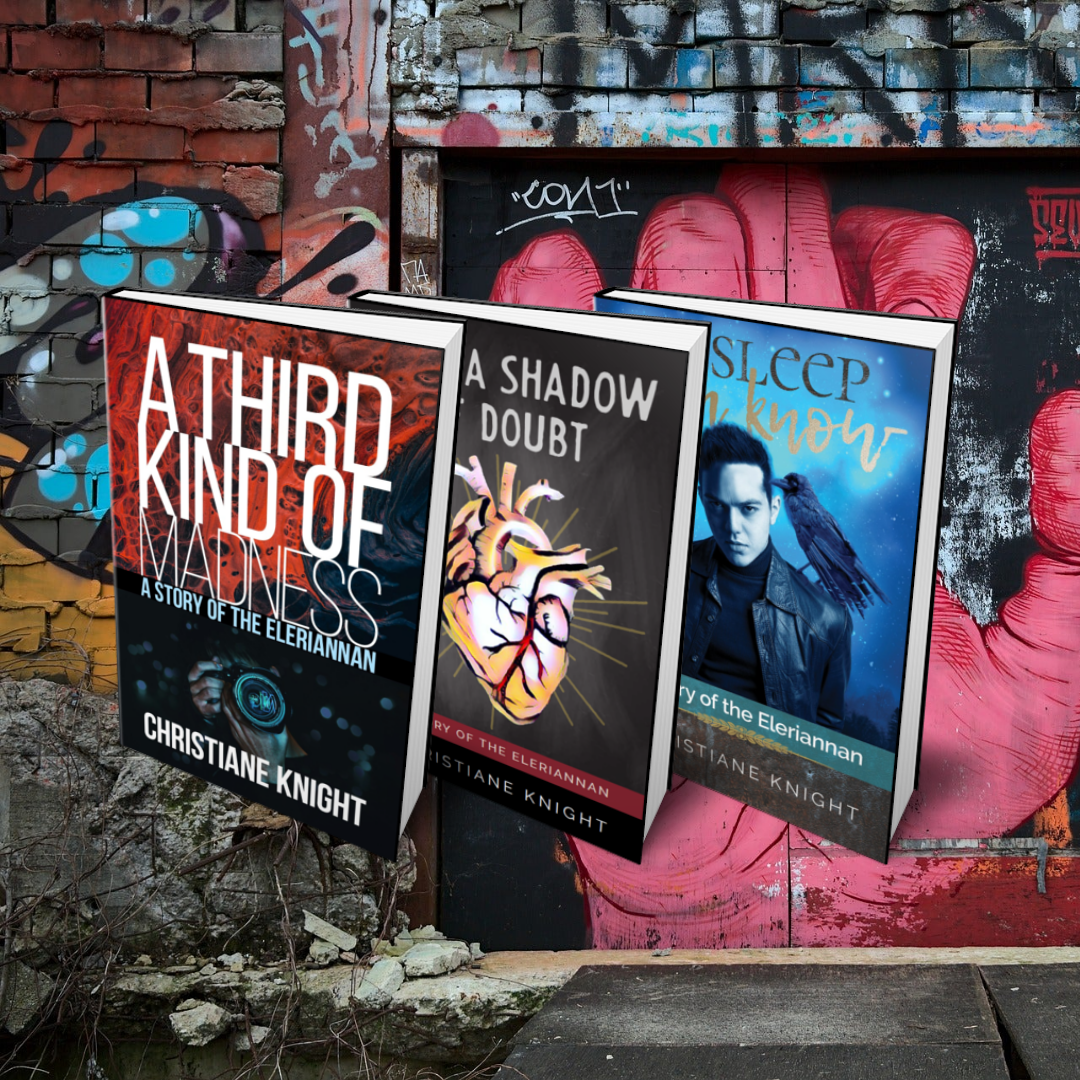
Three book covers against a graffiti backdrop

Seven Things About What I Write

For no reason except that I like to talk about my characters, settings, and themes, I’ve put together this [hardly exhaustive] list of things you can find in my stories.

Look, it’s a list!

  1. My stories center around Baltimore.
    Why? Because I’m from here. The city and its surroundings are a place filled with beauty and quirkiness that are often ignored in favor of focusing on the darker aspects, ones that get a disproportionate amount of screen time on TV shows and in movies. Those things are there, but it’s not all there is to Baltimore by far, and part of my goal is to rebalance things by telling hopeful stories set in a place that deserves them. Also, B’more has so many hidden treasures and interesting people. It’s the perfect place for a community of Fae to live without much notice.
    Most of the places I mention in my books are real places, or based on real ones. I’m planning a video tour of Fae Baltimore at some point soon!
  2. My stories are hopeful. As I mentioned above, I write books where the characters – no matter what they’ve been through – tend to work toward positive change and helping each other. There’s room for forgiveness and transformation here, something that reflects my own stance on life but also serves as an option for folks who are tired of the preponderance of grim, heavy stories out there and want something that encourages them to look at the world with fresh eyes. I don’t shy away from tough and painful topics, but I address them with small, positive steps that anyone – not just magic wielders – can take.
    It’s important for me to allow room for things like the possibility of redemption and the importance of community in these stories.
  3. My Fae characters are not inexplicable or confounding. In a lot of Faerie lore, the Fae are unpredictable, impossible to understand, without rhyme or reason to us mere mortals. In my stories, that’s not the case, or at least, not exactly the case,
    The closer that the Eleriannan and Gwyliannan live to mortals, the more they seem to be like us, with concerns and motivations that mortals can comprehend. The ones that are more difficult to parse are the older ones who have begun to separate themselves from the mortal world. And of course, there are beings like the Elementals, which not even the Fae can claim to understand.
    But one of the parts I love the most about writing my Fae is that despite being magical creatures who have lived well beyond the life span of the mortals they associate with now, they still struggle with emotions and relationships and maneuvering through the world around them. The magic they have solves some problems and creates others. They make plenty of mistakes, and also beneficial decisions. They are knowable – and loveable – because despite not being like us, they really are like us in all the ways that count.
  4. My characters care about taking care of the people and environment around them. There are plenty of social and environmental issues that are important to Baltimore that the characters address on a regular basis. Homelessness, racism, gentrification, pollution, poverty, environmental responsibility, justice, healthcare, class, and inequality are just some of the topics that characters touch on.
    They model helpful actions, too – especially Vali, an activist who puts her energy into using her magic to protect community projects and organizing cleanup sessions at the local waterways. The Gwyliannan contribute to their area by magically protecting the neighborhood from crime and other intrusions.
    I want to leave readers feeling like they can do more if they want and there’s a place for them out there with others who work towards positive goals.
  5. I like to refer to Faerie tropes and give quiet shout-outs to stories that came before mine. I bury references to all the lore, ballads, poems, and classic literature about the Fae that I grew up with, as well as nods to works by more contemporary authors that I’ve loved, throughout my stories. Sometimes it’s very subtle, other times quite overt if you’re familiar. It’s both a tribute and a way of connecting my tales to the bigger collection of lore out there. Also, it’s fun!
  6. I make up my own creatures and lore. Eleriannan, Gwyliannan, and Grimshaw. The Lady of the City. The Nyxen, Ffyn, Arswyd, ArDonnath. Those all came from my own head, though of course with plenty of precedent from the classics mentioned previously. I feel like a thread of truth runs through every interpretation of various magical beings and creatures, and mine are just one version of things that can feel both unique and familiar all at once.
  7. My characters are a little too real! I’ve been told time and again that they feel like people that my readers know and love like old friends. And to be truthful, they feel like that to me, too, even the new ones that show up unbidden to take over my stories. [I’m looking at you, Denny.]
    I’m often asked if they’re modeled after people I know and the answer is both yes and no. Certain people definitely had some influence over the beginnings of some of the folks in my stories, but once I started writing them they began to get minds and wills of their own and often will surprise me with some of the choices and directions they take.
    It’s quite delightful.
    Because of that, they get deeper and more complicated as the books progress, and that makes them much more interesting to work with. They show up in my dreams as often as they do on the page, and I’m fully expecting to round a corner one day and run headfirst into Lucee or Merrick or Denny.

There’s actually a lot more I could say about what I write – and why – but I’ll leave it at seven for now. What’s most important is that these books are intensely personal to me, and filled with details that I feel good about. I hope you enjoy them too.

person s hands

Fierce and Fragile

I am, in turn, fierce and fragile.

My left hand is smooth. On my right, the skin is rougher, from hard work. Because of this, I wear my jumbled pile of black rubber and sterling silver bracelets on my left arm, so they do not get in the way when I Do Things. I make it up to my right arm by the permanent adornment of a black skeleton key tattoo.

Smooth or rough, my hands are strong. I use them to grasp and pull and lift, and then I work with the most sensitive part of my fingers – the tips – and shape and draw wool into yarn with great control and skill. I am capable of extremes.

“What about this thing that you gave
What if it weren’t quite perfect
What if there was something bad about it?
Wouldn’t you still love it just the same?
Wouldn’t you still care about it?”

Victoria Williams, Lights

When I am “up” I am often deliriously happy, in love with the world. No color escapes my sight, no touch from my lover taken for granted. I revel in the cool breezes, the look and feel of my clothing, the way my body moves. I am never more alive than in those moments.

When depression creeps in – sneaky, unnoticed until I am full in the throes – I feel heavy, pained. I notice the same things, but the delight I get from them is muffled, no matter how I try to break free from the web of grey that wraps around me. I am still the same girl, but I am covered in a shroud of melancholy.

And writing that, I feel melodramatic… but it’s true, as much of a truth as my two hands which are part of the same body yet so different. Knowing this, accepting this – it helps. Each hand has its own strengths and weaknesses, its own adornments and looks. That is the way that it is. I can’t reject that. I don’t have to wallow in the weaknesses of my left hand to appreciate that it looks less aged, less haggard. And I don’t have to feel bad about my right hand looking rougher, marked by time; I recognize that it has worked hard and created many beautiful things. Together, they work to write this blog entry and share my words.

I love them both, because they are mine.

Never, Always

We’re in a field of flowers, yellow and purple and blue. You’re the prettiest thing there, dressed in soft grey clothes, cloudlike and serene.

You spin in a circle, arms outstretched, joyful in that moment. I can’t take my eyes off of you. Your laugh is my favorite sound.

We’re in a tearoom, with dark wood walls and furnishings, straw mats on the floor. I sit, cross-legged, and you lay back with your head in my lap, dark hair spilling across your face. I need to comfort you, though I don’t understand why. It doesn’t matter. I’ll be here for you, like you have been for me.

I touch your face to wipe away your tears, and the look you give me makes my heart ache. You’ll never be mine. I’ll always be yours.

“Not in this timeline, dearest one. But somewhere else, we are together,” you promise me.

I have no choice but to believe you.

For more about my Oneiromantic series, start here: Oneiromantic

Text: Good vs. Evil? Nah. Background is a hooded and shadowed man against a grey wall.

Good vs. Evil? Nah.

My stories aren’t for everyone.

Some people want it dark, and my books are not that. They have dark moments, and people who do bad things, but the overall atmosphere is hopeful, built on the idea that we are strongest when we work together.

I don’t write the kind of fantasy that has obviously evil villains. I don’t believe that there’s that many purely evil people out there, so what are the chances that our everyday fae-befriending main characters would be running into Big Evil?

Even the Camlin, the Big Bad from In Sleep You Know turns out later to have a much more complex history than “I hate everything and especially you.” [You’ll have to read Cast a Shadow of Doubt to see how that goes!] The Arswyd and the other Grimshaw, too – they have their own motivations for why they act like they do.

Rather than focusing on evil as a motivator for a storyline, I’d rather explore the traumas and misunderstandings that lead people to the choices they’ve made. I talk about broken and dysfunctional families, social pressure, being without a house or a community, feeling inadequate and powerless – and how all these things shape how we move in the world. The magic parts of my stories are more than just the powers that the Fae bring. They’re all entwined in the decisions that the characters make.

You might ask, then why even have magic in these books? Why are they fantasy and not just books with “regular” characters? What a great question!

Having magical characters serves a couple of functions.

It demonstrates possibility. The magic is a way to shine a light in the darkest times, a beacon for what good can exist even in the midst of struggle.

It offers balance and perspective. Even the mightiest of the Fae struggle with everyday issues, ones that magic can’t solve, like relationships. And when the mortals get magic, it doesn’t change their flaws either. Merrick and Lucee both still have to learn how to believe in themselves and what they are capable of, with or without the use of magic.

Creepy pale woman in a black dress stares down the camera

And honestly, one of my favorite things about my characters is watching them learn how alike they all are, Fae or mortal, despite their obvious differences. The creepy, uncanny Ladies have internal power struggles. The Ffyn are happy-go-lucky dancing trees until it’s time to defend their friends. Merrick leans on his companions whenever he’s unsure what he should do, and that includes the Fae once he’s decided that he’s with them.

As the stories progress, the characters begin to work through their assumptions and prejudices as they discover their commonality. And I’d argue that’s another kind of magic.

Every protagonist needs a foil, but that doesn’t mean that we need to always have the divisions be starkly divided. And don’t get me wrong – there’s nothing wrong with cartoonish villains or implacably evil characters or whatever other types of villains you enjoy reading or writing! They’re just not what I write, and they’re not the kind of fantasy novels I’m interested in bringing into the world.

I crave hopeful stories with plots that address issues I see in this world, and that’s what I write. Which is why I can confidently say that my books aren’t for everyone, and that’s okay – but I think you might be surprised how much you can relate to what happens in the Baltimore of the Eleriannan.

A tarot deck with the Star card on top, text that says The Power To Pivot, Photo by Photo by Viva Luna Studios on Unsplash

The Power to Pivot

This isn’t about writing, not exactly.

It’s about how life can change in the blink of an eye. And it’s about how those changes can be traumatic but also can usher in a new – and possibly better – phase of one’s life.

In tarot, the Tower card is generally viewed with trepidation, if not some well-founded fear. It’s all about seismic change, the upheaval of everything you’ve become accustomed to, whether you like it or not. Sometimes that means chaotic change. Other times that change, although life-altering and possibly painful, leads to better or at least more grounded things. A lot of the time, how it resolves depends on how you respond to the events.

Thing is, inside that Tower moment, everything sucks. It’s traumatic! Change, especially unexpected change, is difficult to process and often painful. But it can lead to transformation, too. There’s a reason why the Star, a card of hope, follows the Tower.

For a lot of people, the COVID lockdown was a Tower moment, and understandably so. There were so many changes in such quick succession! Even now, things are different than they used to be in many ways, and we’re still figuring some things out. For me, the lockdown was actually the transition from the Tower to the Star.

See, I was rushed to the hospital with my emergency small bowel resection at the end of August 2019. THAT was my Tower moment: I could have died, it restructured everything that I knew about life, and I was put out of commission for months. I’ve written plenty about it, but here’s where the title of this text comes into play – because just when I started to pick up the pieces of my life and contemplate returning to what I used to do, COVID showed up and kicked all those plans in the nuts.

You might know that I was a full time fiber artist before I wrote In Sleep You Know. It’s a very physical job that had me doing a lot of events and making yarn and fibers to sell every day. I loved it, and I was doing pretty well at it before everything went bust pun intended]… but I was feeling pretty burned out, too.

In part, that’s because I’d been sick for a while but I didn’t really understand that. Crohn’s presented a lot of symptoms that I excused as being “just a touchy digestive system” or “a picky gut.” I mean, you feel like that every day and you learn to adapt or convince yourself that you’re just being a big baby about it or whatever. Also, I hadn’t had much luck in getting doctors to take me seriously, so there was that. So I was tired and in pain a lot, and that made it difficult to do what I loved, and tough to love what I did.

I’d actually just started coming back to working with fiber and doing shows after the surgery when the lockdown happened. My last show was in March of 2020. I was so happy to be there but physically, I was miserable. I was wondering if I was ever going to be able to do a bigger event again.

I was ready for the pivot. I just didn’t know it yet.

I spent some time over that first Lockdown Summer doing online teaching and a creativity group. I love teaching but there’s a different skillset that you need to do it through video, especially for something hands-on like spinning yarn. I adapted, but I didn’t love it. And my medical treatment wasn’t doing enough, so I was tired all the time… and depressed. I could feel the depression looming. It had been building since the surgery, because so much changed, including me and my body.

One day, I was digging around in my files, and I pulled out an old story fragment that I’d written a while back. I re-read it, and my spark to spin tales reignited. Suddenly, I had motivation again, as the story of Merrick and Aisling and the Eleriannan started to blossom in my mind, and I began to write down the new story that came from that fragment.

At first it was just something to entertain myself. Escapism, maybe? A Baltimore with a secret Fae population was a lot more exciting than a city where no one could see each other face-to-face. But as the story grew and my love of writing came back to the forefront, I began to wonder… could I publish this? Could I become an actual “legitimate” author, and not just someone who used to get published in small press ‘zines?

I whispered the idea to a few friends, slipped one or two people an excerpt. I was enthusiastically encouraged to keep going. My confidence built, and then I decisively proclaimed one day, “I am writing a book! I will be publishing it soon!”

Pivot achieved.

Obviously, a LOT more happened after I made my great pronouncement. But the act of claiming it for my own, that was the important point.

It took more work on my part to start telling people that I am an author rather than a fiber artist. That has been my major identity for almost 20 years! I’m still a fiber artist, of course, just like I’m still a DJ even though I don’t spin music at clubs or on the air anymore. Those are part of my identity.

But these days, being a published, honest-to-goats author is my main identity, and it’s one I dreamed about since I learned to write. So in a way the pivot is me coming back to my earliest sense of self. A homecoming, if you will.

There’s so much power in that. Here I am, living my childhood dream.

I didn’t get here in the way I expected, but if it wasn’t for that Tower moment I might not have ever have found my guiding Star.

If I build it, will you come?

What I want, as a writer, isn’t for someone to tell me their One True Way to be successful at what I do, or the Best Way To Write A Novel, etc etc etc.

The world is FULL of people offering that. And I’m not knocking anyone who sells that, or who wants to consume it! You do you, boo. I can’t determine or decide what you best need in your journey as a writer.

What I’ve noticed, though, is that there are so many products and communities built around people who haven’t written their first book/story yet. The other one I see is centered on those who have something written but haven’t sold it yet. They’re both valid communities to serve, with lots of people who need that direction.

But that’s not me.

First, I don’t want to be “sold” anything.

If I choose to buy a class or a program, it’s because I found it on my own while looking for a solution. I don’t want to be marketed to, and I don’t want to have to pay a ton of money to people who often I can’t even find credentials for. I choose classes from established authors or editors that I know and respect. I am extremely picky because my money as a working author is hard earned and scarce!

What I really want is a community.

Photo by Mike Erskine on Unsplash

I want a community of like-minded people who are sharing their experiences honestly and candidly, so we all can learn from each other. I want people who are traveling a similar path and who are ready to cheer or console or advise each other as needed or wanted. I want us to support each other with our time and money as needed and as we can afford to, without any pressure or, goats forbid, marketing.

And I want it in a container that feels safe and welcoming and nurturing.

Is that too much to ask?

When I started posting on Ko-Fi about my own journey as a writer under the title A Writer’s Life and Craft, I made it a paid tier because a. I am poor and need money, and b. my experiences are worth something and it does take time and energy to write about them. I set the price as an affordable one because, well, see “a” – I understand that lots of us are poor. I want to reach people like me, who aren’t adverse to supporting folks who are sharing their hard-won experiences, but don’t have a lot of money to spare.

I even set up a Discord for my Ko-Fi, with separate spaces for readers and writers. I was hoping a community would build there, but it’s mostly a ghost town. I’m sure in part it’s because people who aren’t Ko-Fi supporters don’t know about it. I want a community to grow organically, just like support for what I do has done.

But with that being said, how do I carefully nurture and build what I want to see in the world? If I build it, will you come?

* I’m giggling over the lead photo, because I wanted a writing community shot with representation of many different people. What I got was a math study group. But this is an equation I can’t seem to balance, so I’m sticking with it. Also I like that pom-pom pen.