I’m writing this hours after the Winter Solstice, cozy under blankets on the couch, the room lit by warm holiday lights. As always on this day I’m thinking about what it means to know that daylight will last a little longer every day until Summer Solstice, but the weather will get colder before the change in light seems to make a difference. I consider what seeds I’ll plant–botanical and metaphorical–and which will grow and thrive.
Not all seeds make it. Not all plans succeed.
“The grey of winter falls on us – How will our garden grow ? Will all the seeds we’ve sown Survive beneath the snow ?” – All About Eve, Wildflowers
I used to sing an a capella version of this song to close out The Violet Dawning sets. I think it sums up my feelings about this season well, despite being about a relationship. The uncertainty, the knowledge that growth or retreat can change everything and that’s natural but painful…but eventually there will be flowers. The sun will return, and even if everything’s different, change can bring beauty.
So what seeds am I considering?
I think it’s important to bring up my Word of the Year in this discussion because it expresses well what I’m looking to embrace in 2026 and beyond, if possible.
I chose EMBODIED as my Word of the Year. If you’re on my mailing list, you’ve read about this, but I’ll share it here too, both as a public record of my choice and an explanation.
What do I mean when I say “embodied?” There are a couple of ways to look at it, and I embrace them all. From the concept of embodied cognition:
“By using the term embodied we mean to highlight two points: first that cognition depends upon the kinds of experience that come from having a body with various sensorimotor capacities, and second, that these individual sensorimotor capacities are themselves embedded in a more encompassing biological, psychological and cultural context.” — The Embodied Mind: Cognitive Science and Human Experience by Francisco J. Varela, Evan Thompson, and Eleanor Rosch, pages 172–173.
[Check out the Wikipedia article on this for a good overview.]
Embodied can also be defined as being the representative of a quality, or an idea. A good example would be referring to a dancer as the embodiment of grace. Or: to give body to a spirit, incarnate.
I want to be more present in my body, and experience more of the world through my body. Being ill has kept me away from being one with my senses like that as much as I’d like and my goal in 2026 is to change that, to the best of my ability. I also want to be even more in tune and aligned with my ethics and goals, in every way possible. I think I do a fairly good job of that but I know there’s always room to improve. And—I think the third meaning supports the first. I want to be a better home to my own spirit. I spend a lot of time feeling like a brain in a jar and I need to find a way to incorporate and incarnate my mind into my body so once again we are one.
I think some people with chronic illnesses might relate to this goal in some way or another.
What I want is to be more present, grounded, and ALIVE.
My plan is to be more intentional in what choices I make as far as going out, expending energy, choosing projects. I want to have more nature walks and visiting places that give me joy, because a lot of my life currently is spent in places not of my choosing. My living room is quite pleasant but I don’t want it to be my entire world. I need to visit doctors but it would be great to balance that with indie bookstores and farmers markets.
And I miss some of the creative pursuits that I used to enjoy, too. Spinning yarn, weaving, photography–those have all taken a back seat to just surviving, and using what energy’s left to write. I love writing with all my heart but I need other experiences in order to keep that writing fresh and lively.
Taking stock is important.
I don’t do resolutions. I don’t like the baggage around that word and concept. What I do enjoy is looking over my past year and taking stock of what successes I had and unfulfilled wishes I can move to next year or release. I’ll post that once I’ve compiled it, don’t worry. I think part of the process is showing that even in slower years, a lot happened!
In the span between now and the end of the year falls Christmas, my birthday, and New Years Eve. That’s a lot of time to review and assess. Look for another post talking about my numbers, conclusions, and what to look for in 2026 from me. Until then I hope that whatever you celebrate that it’s a lovely and restful and comforting time.
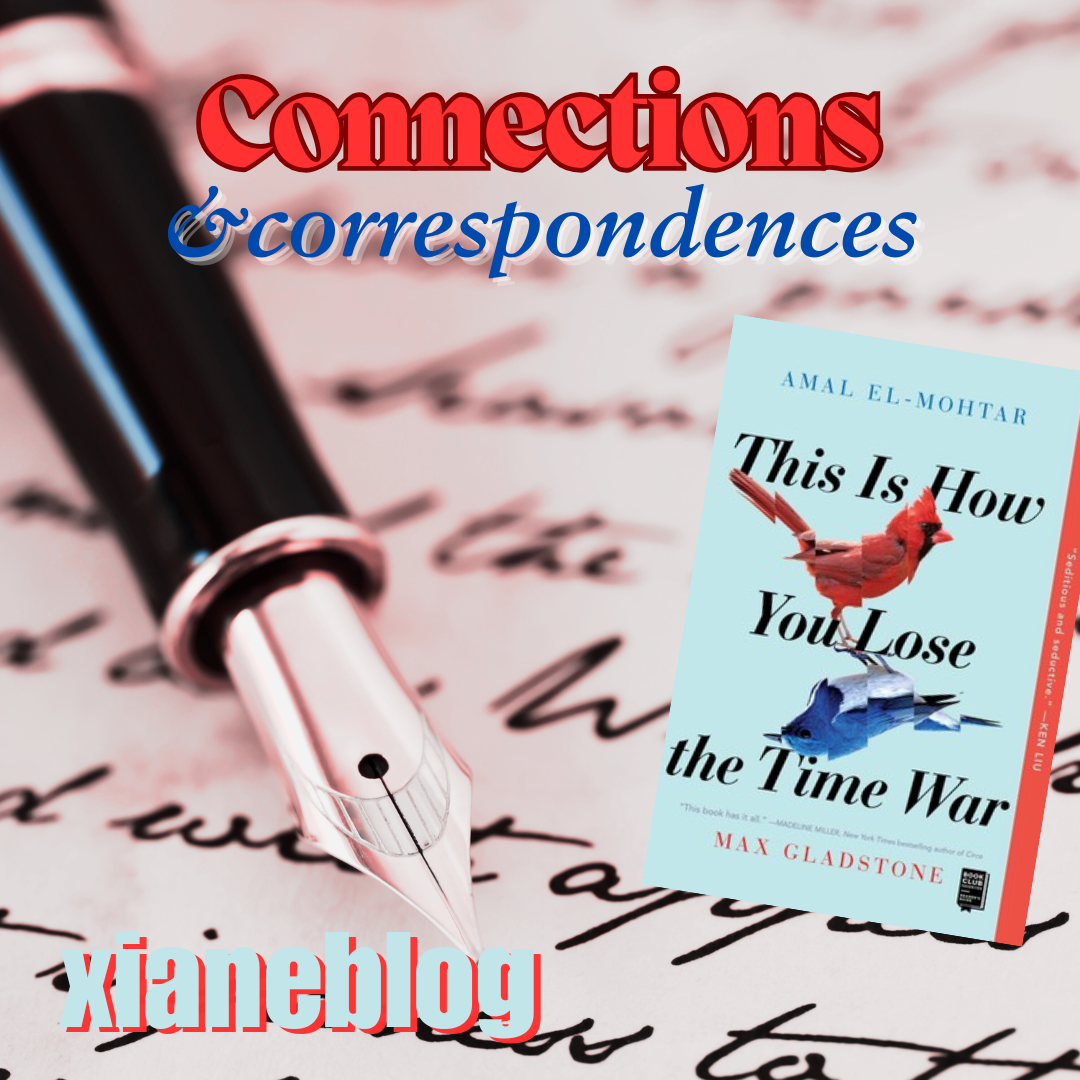
I just finished reading This Is How You Lose the Time War by Amal El-Mohtar and Max Gladstone, and I enjoyed it immensely. The raves about it are entirely justified, and like the best books out there, this one has inspired a lot of emotions and soul-searching.
The story is told through a mix of styles, prose and epistolary. The two focal characters are on opposing sides, with seemingly conflicting belief systems, in a battle through time and timelines to influence outcomes that further their worlds’ goals. One of the characters leaves a letter–via arcane means, a delight to read about–for her opponent as a taunt and challenge, but also an invitation.
That sparks an ongoing conversation between the agents that beautifully, delicately, threateningly grows into so much more: a connection, a rivalry, then an exchange of philosophy and purpose and the secret things that live inside their hearts–things that they’ve shared only with each other. They become hopelessly, delightfully, dangerously entangled.
“So I go. I travel farther and faster and harder than most, and I read, and I write, and I love cities. To be alone in a crowd, apart and belonging, to have distance between what I see and what I am.” ― Amal El-Mohtar, Max Gladstone, This Is How You Lose the Time War
Like Red, I’ve lived a life where I’ve been separated from others, an oddity with specific skills that help me pay attention to tiny but important things many others miss or ignore. Like Blue, I have a need for a connection and a love for multi-layered meanings in carefully crafted paragraphs. [Things are not this simple in the book or in real life, I should note.]
I have a long history of using correspondence to connect with people who might understand me more fully than the ones I encounter in everyday life. I have a difficult time forging deep and meaningful relationships in face-to-face situations; I’m both too intense and too withdrawn, made of glass that lets people see inside without actually interacting with those internal workings. A lover once said that I was “secretive” and they meant as “a person who hides their true self and thoughts away.” It baffled me, because I’m transparent, as I said.
But they were right in one way: because they didn’t try to crack through the glass to get to the treasures behind it–the promises made by appearance but only accessible with work–they didn’t get to know the inner me. They just saw that it was there and untouchable by them.
I’m not easy to know. I am, but only if you share proportionately, and people often don’t. And then they wonder why the Me they know is there isn’t just presented to them.
Letters? They’re an equal trade.
You write, and when you first start a correspondence, you’re feeling out the other person, this unknown who might have left you enough clues to guess what might tickle their fancy enough to respond back. You dribble out a small bit of who you are with the ink that helps you compose those [hopefully] clever sentences, wooing the person on the other end to do the same, maybe even more bravely than you did. It’s a tease, a challenge, an invitation. It’s intimate.
Not every potential correspondent will accept your dance of words, and that’s fine; just like any interaction, you don’t want to waste the good stuff on an unworthy partner. But when the connection sparks, when the writer sees what you’re offering in the carefully outstretched hand filled with paragraphs hinting at the possible delights to come…that’s magic.
“There’s a kind of time travel in letters, isn’t there? I imagine you laughing at my small joke; I imagine you groaning; I imagine you throwing my words away. Do I have you still? Do I address empty air and the flies that will eat this carcass? You could leave me for five years, you could return never—and I have to write the rest of this not knowing.” ― Amal El-Mohtar, Max Gladstone, This Is How You Lose the Time War
In my time writing to strangers that became friends or foils or occasionally educational experiences, I learned how to search different spaces where potential conversation partners gathered and winnow out the ones that would never give me what I was looking for, narrowing my choices down to the best of the bunch before I would launch a probing missive their way. I went from the back of magazines, pre-widely-accessible-internet, to newsgroups, then eventually places like Craigslist. In the process I gained a few unshakable friendships, a few enemies, and one connection that felt very much like the beginning letters from Red and Blue, and just as tumultuous. I had another that I met in person but the bulk of our connection was built from letter-writing, where we were free to talk about much more intimate topics than we ever felt comfortable with face-to-face.
The last correspondence I had became a real-life dalliance that broke my heart with the push and pull dynamics involved; I’d finally met my match with someone who glass-walled me, but with no invitation to break through. It was all “look, but don’t even try to touch.” Whereas I’m emotionally available if someone would actually make the effort, they were all rocky shore and no way to access the lighthouse. Which…fair enough, they are who they are, and I knew enough of their story to guess why that was the case. But it cured me of reaching out in that way, until I met my current partner — someone brave enough to make that effort and crack my protective glass.
Which brings me to my current story.
What I’m writing now is very much an ode to breaking through those invisible barriers, reaching out through anonymous means [in this case, a version of Craigslist] to connect with a stranger with which to become entangled. In the process, the characters reveal their secrets and learn what it means to be fully present for each other…and better humans. In Tryst’s case, she very much is like me: someone looking for meaning through reaching out to the unknown. Even though she’s got people who love her, she’s closed off from them in many ways. It’s a love letter to those times, to the hurting and isolated version of myself and others like me who want something bigger than casual connections. No one else could write it, so I’m writing it for myself, so I can feel seen.
Stories that make me feel seen are rare. This Is How You Lose the Time War did that, in the most poetic and delightful way possible.
…I want us to forget them [Wild Flowers, All About Eve]
I drink the tea that I let go lukewarm while I think about winter, and holidays, and the progression of time. It’s still early in the day for me, 10am–but I get up later than a lot of people do. I’m already dressed, but not quite ready to leave. Today Mom and I will go to the Festival of Trees, a holiday charity event for Kennedy Krieger that we attend every year, braving Black Friday traffic and poor drivers to get there and look at a display of themed Christmas trees and wreaths while we fight against crowds.
I hate being trapped in the throngs of people but I love the spectacle and the magical feeling of the event, so I put on my mask and deal with it, even though I know we’ll probably be the only masked people there and that I’ll be utterly exhausted afterwards. The holiday season is filled with complex feelings like this; I celebrate Yule and [secular] Christmas, which often feel at odds because of [religious] Christmas. Both Christopher and I have birthdays that are crammed into the holiday weeks. His comes before and mine is stuck in the weird limbo between Christmas and New Year’s Eve. Winter holidays are always a bag of mixed feelings because of this. I get a year older, the world gets a year older; time marches on and has its way with us and while I’m glad we’re both here, I think we’re both feeling the weight of our age.
So the holidays have always been magical and joyful, but underpinned with a melancholy that’s haunted my life. No matter how happy I am, there’s always that existential dread under the surface, and I’m grateful for every twinkling light and jingle bell that helps distract me from it. This year the dread is louder than ever, because of *gestures widely at everything* –and I have no idea how to fight against it other than to lean into the magic and found moments of joy and being as kind as possible to everyone who doesn’t want people like me or those I care about to die or disappear. I’m especially focusing on those who are in positions of less power and luck than I am. They get all my kindness and whatever assistance I can offer.
That’s the best way I know to beat the winter doldrums and fight against the rising tyranny. I don’t care about stuff. I want kindness and justice and actually, yes, the downfall of this late-stage capitalism driven hellscape that the US has slid into. I can’t do much to put my boots to the ground in this fight, but I can contribute the skills I have. That includes my words, because words are powerful. It includes my resistance to being ground down by the ones who profit from it.
Fuck that, I’ll live and be joyful out of spite if I have to, if it burns their buns to see me out here disabled and queer and living my best life despite whatever dystopia they want to throw at us. Radical fuckin’ joy, my friends. I’m going to weaponize it if I have to. Let’s thrive despite all their attempts to crush the spirit out of us.
.
A little note: I have a long history with this song, and actually used to do an a capella version of it occasionally back in the days of The Violet Dawning. It means a lot to me.
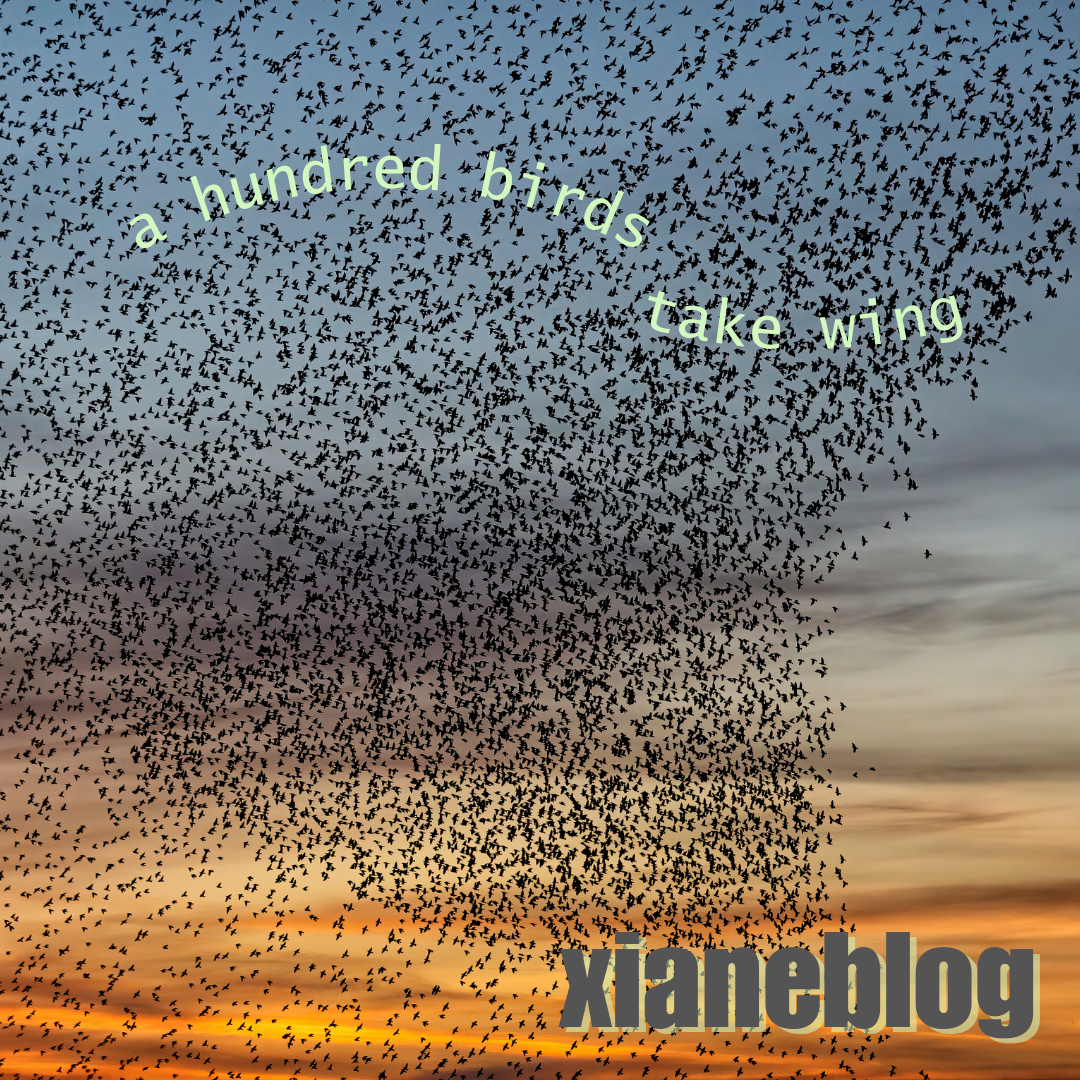
In the space before the rain comes, there’s a great gathering of birds above me; in the trees I hear the clatter and chatter and rustling of feathers and wings of the starlings have come to rest, if anyone can call a chattering of starlings a thing at rest.
I wait patiently for them to move on. They won’t stay roosted for long. Perhaps if I’m lucky they’ll murmurate for me.
I’m at rest where they are not, although my rest is also suspect because my fingers are moving across the keyboard, my mind is moving across my threads of thought.
The delight and sorrow of being a thinking person is that it. never. stops. My brain is constantly turning over thoughts and dreaming up connections. I’m telling myself stories non-stop. There’s an internal monologue that fills every moment, analyzing and commenting and sharing secrets with myself, like there’s more of one of me in there when there certainly is not.
At least I never feel alone. I am my own best company.
Despite that, I still long for someone I could spill all these random sparks of idea and correlation and song lyric and storyline to, free from context or connection, and have them just get it. You know? It’s a pipe dream, I understand that. I can’t just open my head like a cauldron and pour my thoughts over someone’s head. But what a relief it would be.
I started reading so early that I have no functional memory of life without it.
My family was poor but we had full bookshelves and both my mom and gran [who we lived with] were voracious readers. Mom read to me and had books for me from the very beginning, and I took to reading easily and with much excitement. I think being curious and having a deep desire to know helped, but having a reading culture modeled for me was the most important part of the equation.
Mom knew that she could get toddler me to behave when we were out in public by offering to buy me a Little Golden Book. My relatives were encouraged to buy me books as gifts, and when they saw how happy that made me, they were thrilled to keep up the tradition. My beloved Aunt L, who had more money than we did and was always kind and generous, bought me some of my most treasured books–ones that Mom would have struggled to afford, like sets, collections, and encyclopedias of knowledge. I think she loved doing it because she understood what an impact her gifts made on me.
I mention money here because books are expensive, always have been, and it takes money to have one’s own library. As a kid I had more books than some adults I knew! I treasured my Collier’s Junior Classics, where I got a taste for folklore and mythology that would fuel further exploration and then the books I write today. I had an encyclopedia set of animals [bought by Aunt L] that sparked my obsession for wildlife and helped me spout facts at my partner whenever we watch animal videos or go to the National Zoo. All those books I owned helped form who I am today.
And don’t get me wrong, I went to the library religiously and would emerge with armfuls of books every time. I am an extremely fast reader so I would blaze through my pile and then read everything that Mom took out, too, even if it was “too old” for me. If I had questions, I’d ask Mom or use the dictionary to help me. My intellectual curiosity was fueled by not being restricted in what I could consume, and not being shamed if I asked a question that might be uncomfortable or that others might brand as too advanced for my age or experience. I had a safe home, in that way. I was encouraged to learn everything I wanted to, at my own pace. [This was a problem for me in school, unfortunately, and I was often bored and frustrated, forced to adhere to the pace of my peers. Not that I was any smarter than them, I just had an insatiable curiosity and lightning fast reading speed.]
Thing is about the library: it is an important–crucial!–resource, but having books in the home, at one’s fingertips whenever wanted, is important for keeping young minds invested in reading. These days, we’ve got the Internet to answer all our questions, but when I was a kid, having a big dictionary and encyclopedia was formative for me. I spent a summer reading the entirety of them from front to back, which explains a lot about me if you know me in person. You can’t force that kind of obsessive need for info, you can only nurture it. Getting an early start at reading, in a home that valued education, was vital.
And let me be clear here: my family was lower class blue collar. Until my mom and I went to college [at the same time!] we didn’t have anyone in the immediate family who had done the same. When I learned to read, I lived in an apartment with my mom, her sister, and their mother–my grandmother. We struggled, and I even shared a bed with my gran for years before my mom got married and we moved up in status a bit. But there were always books, always reading, always great value placed on learning things.
What’s my point in all of this?
We need to start kids reading early and enthusiastically foster the love of it by modeling a reading culture. Doesn’t matter if it’s a paper or electronic book; what matters most is the unfettered access to reading material and an unfaltering support for exploring whatever sparks a child’s curiosity. Don’t depend on your kid’s teachers to do this for them! It needs to start well before they hit their school years. If you’re like me and don’t have kids, gifting books or reading to young people is a good way to help. I think of my Aunt L, who invested in a kid that wasn’t her own, and what it helped to support. You can make a difference.
Also, there are programs like RIF – Reading is Fundamental – which make sure that kids, especially kids in less secure financial circumstances, get access to books in their own home. You can donate money or time to them, or organize a book giveaway with their help. They’re not the only organization that does this! A quick online search will reveal many more.
Investing in our future means investing in kids, because they are the future. One way to do that is to encourage curiosity. Reading opens so many doors. Let’s give kids every opportunity to walk through those doors with all kinds of possibilities in front of them.
What do I miss? The kind of personal blogging that hit its height in the early 2000s, on Blogger and Diaryland and Livejournal, where people would pour their hearts and thoughts onto an electronic page in equal parts of honesty and cringe, or would write banging, impassioned long-form essays about both the most important and trivial of things.
Dear reader, I was one of those folks and I loved it.
Did I overshare, whine, and ill-advisedly spill my feelings in ways that had personal blowback for me? Oh yes. I also wrote some of the best things of my life, met people I’m still friends with thanks to bonding over our overly-honest shares, and felt more connected online than I have at any time – thanks to my blog.
I was real and messy and complicated and so were most of the other people on those platforms. For every moment that I can look back at with some regret there are a hundred other ones that I treasure.
Everything online feels fragmented these days. Formats get shorter and people breeze by each other in the faster-moving platforms that are popular now. It’s not just nostalgia that moves me to feel like this. I pose that deep connections are much harder to come by online, and that didn’t used to be the case. We have shorter attention spans, too, and that’s showing up in a lot of ways. [I miss songs that are over three minutes long!]
The reality is this: I can bitch about it, or I can do something about it. Well, in this case I’m gonna bitch and do something about it, ha. I can’t necessarily influence the world into changing with me, but I can put out into the world what I want to see. That’s been my driving principle for everything I do! You want it, you make it happen. So here’s my plan: I’m going to start old-school blogging here, along with my regular posts. Welcome to my blog! What I write about won’t be as uncensored as I’d like, for obvious reasons. But I want to share more of me in ways that people don’t do as much anymore, and a “micro-blogging” or newsletter-based subscription service just ain’t gonna cut it. Also, I’m not dependent on algorithms or support from platforms that throw their hands in the air when it comes to hosting fascists.
I’ll tag everything with #xianeblog and put it in its own category, XianeBlog. That way it’s easy to read in order or ignore!
If you’d like to join me, let me know! Maybe we need to bring back Ye Olde BlogRing, hahahaha…oh no I’m going to turn into dust soon, aren’t I.