Monthly Archives: July 2024

4 posts

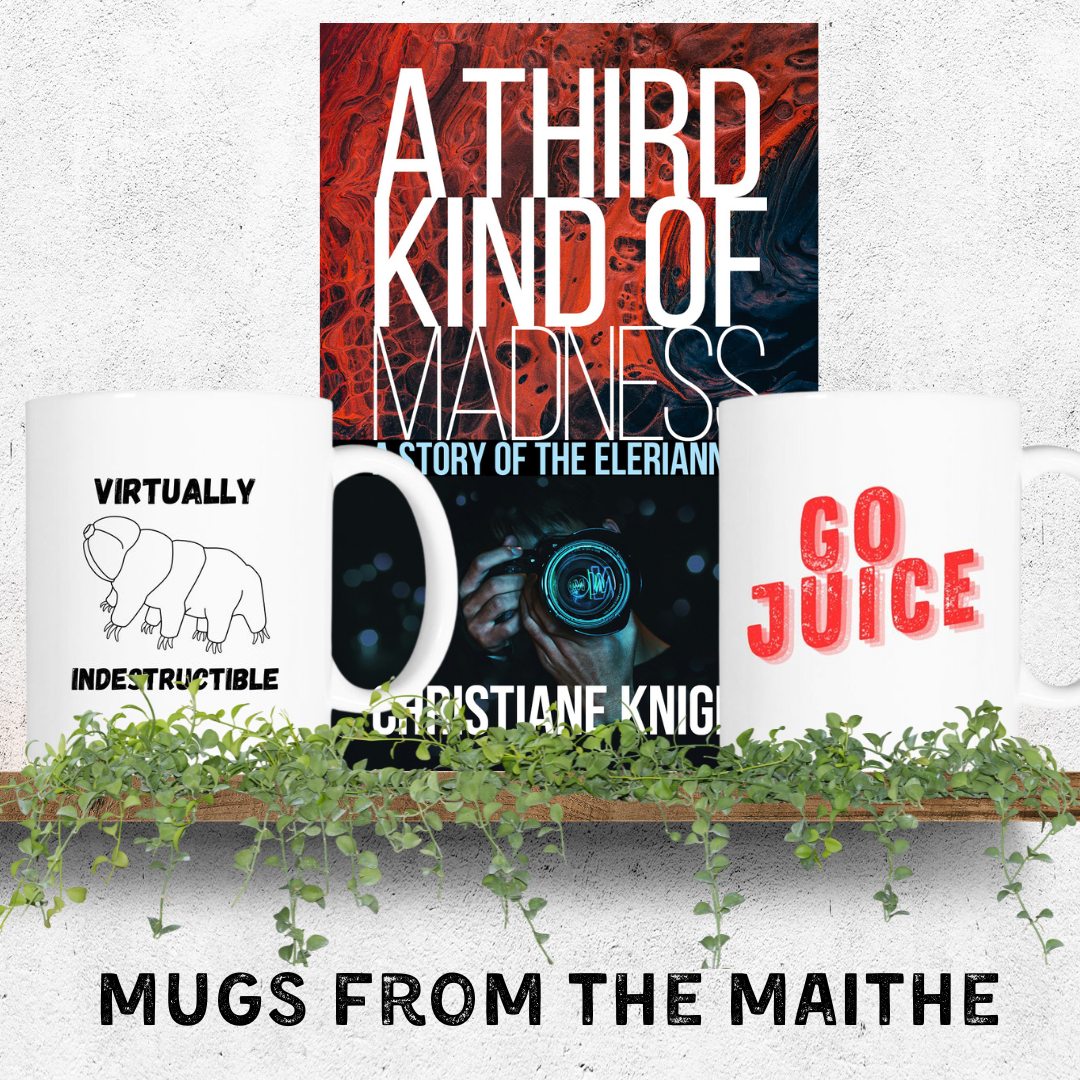
New Mugs, Straight from The Maithe’s Library to You

Getting coffee from the coffee bar in The Maithe’s library is always an experience: first off, it might be coffee, it might be tea, or cocoa… or even a comforting broth in your mug. And the mugs themselves? Let’s just say that they are an eclectic collection and quite representative of the personality of the “sentient, triangular stack of bricks” as Sousa lovingly calls his home.

Denny finding a seemingly endless selection of odd and silly slogan mugs is one of my favorite funny bits from A Third Kind of Madness, and I wanted to bring a couple of my favorites to life for myself. And since I was making them for me, why not offer them to you for your own library coffee bars or whatever your [probably] non-sentient home has going on?

Virtually Indestructible, just like Denny.

The tardigrade, that is, not the mug itself. Don’t use it in fights or to try and scoop up water elementals, that’s a foolish idea!

A white mug, the kind you might find at a diner or ramshackle coffee shop – not the Frisky Bean, of course – with an illustration of a tardigrade and the text “Virtually Indestructible” on both sides. Designed by me, take that as you will, I Am Not A Graphic Designer.

You can purchase this through Bonfire, a print on demand business that I like and use often. I make a small amount per sale, you get a cute mug!

Go Juice: second favorite beverage at The Maithe

I don’t think anyone would argue that the most popular drink at The Maithe is Sousa and Sheridan’s home brew. [At least if you ask them, anyway.] The second most popular bev in house would be coffee.

No one’s exactly sure where the “go juice” moniker originated but suspicions are split between Vali and Merrick. Either way, The Maithe liked the term and immortalized it on one of its white mugs. Or in this case, I did, putting the design on both sides as carefully as possible, because remember: I Am Not A Graphic Designer.

You can purchase this through Bonfire, a print on demand business that I like and use often. I make a small amount per sale, you get a cute mug!

If you’ve got questions, comments, or ideas, send them my way! The Maithe needs more mugs and so do you!

Background is two intercrossed street signs: one reads "Truth" and the other "Love" - overlaid on that is text that reads "The Merits of Being Honest" and the URL christianeknight.com

The Merits of Being Honest

I’ve talked about this before, in other ways and places. It’s a core tenet of who I am and I think about it so much that I find it necessary to expound on it at length often. Honesty is so deeply at the center of my moral compass that it weaves its way into my stories, my relationships, my whole way of moving through the world.

One of the things I talk about when it comes to how I present on social media and other public places is how important it is to me to be open, vulnerable, and honest. If I have any personal “brand” – such as it is, I really hate that concept – it’s being authentic and real. It’s been suggested that maybe that’s oversharing, and that it conflicts with my warning to folks to be careful with what personal info they share on social media.¹ And sure, I probably do “overshare” in some people’s eyes, and I’m not sorry about that. I purposefully talk about things that may be considered uncomfortable, like my chronic disease and its unpleasant effects, or being an older writer getting a late start, or abusive relationships, or being fat and queer and wanting representation in media, etc etc etc. I’m absolutely transparent about what I go through and the steps I’ve taken to be an independent, self-published author. I give away a lot of information and research I’ve done for free. I do also have a Ko-fi where people can get more of these things in exchange for monetary support, but I’m extremely generous with my experience and time. I try to give to others what would be valuable to me in return.

I don’t do any of this for any other reason than it’s who I am.

I come from a DIY, community-oriented punk background, where if there wasn’t something that you wanted or needed, everyone came together to make it happen. I think it’s community at its best, and you can see it show up in my stories too. In fact, that whole “Together we are stronger” attitude is the backbone of my Eleriannan stories. It overshadows every magical ability and is the glue that makes the characters and stories work.

In my personal life, it’s the bar I set for letting people close to me: you must be honest with me, and I will do the same for you. I’ve ended friendships and relationships over the ongoing inability to be crystal clear and not obfuscate the truth. Yes, even to spare my feelings, because the truth always comes out and lies are the insulting icing on top of the shitty deception cake. In return, I offer the same. You’ll always know where you stand with me. I’m not mean or brusque; you can be honest without being brutal. I’m forthright but not cruel. People get that twisted and it doesn’t need to be that way.

People often do small social white lies to smooth out day-to-day interactions, and I don’t do that.² What I do instead is find other ways to communicate positively without being dishonest. Usually that means when I’m asked my opinion about something and I know my answer isn’t going to be taken well, I find a way to frame it that isn’t negative. Being asked for a review doesn’t mean that I need to shit all over someone’s work if I hated it–especially if it’s someone who is new to writing and is looking for support. In this case I might ask if they want a first impression or constructive feedback. Or I could say something like “This kind of story isn’t generally my cup of tea, but I ____” and name a few things that I did like in the story. Asking if I liked something isn’t the same as asking for a critique, and that applies for most things in life. [Just as talking about a problem isn’t opening the floor for advice!]

I can be honest and not crush someone’s dreams.

I can also recognize that my opinions are just that, and I may not be the right person to criticize another, and so I try not to unless expressly invited to do so. The older I get, the more I find that kindness goes farther than the need to be right or be an expert. Maybe that makes me less exciting to follow on social media, I don’t know. That’s okay. I’m always going to choose kindness. And I’m always going to advocate for honesty. The merits of that? You’ll always know where you stand with me, and I can feel good about how I move in the world.

¹Authenticity on social media doesn’t mean that you should give away clues about your personal life that could put you in danger. It’s up to you to decide where that line is. I talk a lot about very personal things but I keep hidden details like links to where I am at that moment for example, posting them after the fact if I want to give positive attention to the business. Usually I only give those kind of details in a timely manner for things like appearances, where I want fans to find me. Be careful with your address and other identifying info that could arm a potential stalker, okay?
² I used to, don’t get me wrong. I thought I was sparing feelings. That was a mistake born out of good intentions that thankfully someone I cared about addressed in a way that stuck with me. I learned my lesson.

A gold trophy spills out many golden stars onto a field of light blue. Text reads: Focus on the Wins

Let’s Focus on the Wins

I’ve been working on what I think will be a short story for a bit now. [A Small Light in the Darkness: you can track my writing progress in the sidebar] It’s been slow going because it’s been hot outside, I haven’t been feeling my greatest, and it’s hard to concentrate while the world feels like it’s falling apart. Even as I’m typing this I’m feeling the sweet, seductive siren call of a nap pulling at me.

But that’s okay. Not the reasons why I’ve struggled with writing much, but that my output hasn’t been where I’ve wanted it to be.

Productivity comes in its own time. There are lots of reasons why you might struggle with the ability to create like you want to, from having to juggle a job and family to–like in my case–deal with a disability that often saps my strength and makes it difficult to focus. Add to that the weight of what’s been happening politically, possible financial struggles or a million other valid and pressing challenges, and it can feel like a real battle to get anything creative accomplished.

It doesn’t make me bad at my job of writing to need to go slower than some other authors do, or have less output. We’re all unique and contrary to the beliefs of some, this isn’t a race or competition of any kind. I write my best when I’m focused, well-rested, and unstressed. Trying to push through pain or exhaustion in order to meet some idea of how much I “should” be writing in a day won’t give me my best work. So instead, I try to set healthy and realistic goals for myself, because I acknowledge that I do perform better with goals of some kind, just not ones that make me feel like I’m in some strange literary footrace, except it’s fingers on keyboards.

When I do get down on myself for not living up to some arbitrary standard or goal that someone else dictated, I like to play the game of “But what have I already accomplished?” You can play along with me, if you like. July, the middle of the year, is a great time to play this game–but really, anytime you need to be reminded of what you’ve already done, no matter how small, this is a fun thing to do.

Mid Year Accomplishment List 2024

  • Condensed entry: all the tasks that went along with finishing A Third Kind of Madness [editing, cover, layout, blahblah]
  • Published my third novel, A Third Kind of Madness!
  • Attended and participated at Balticon 58, including being a panelist and doing a reading from ATKOM
  • Virtually attended the Nebula Conference and was a panelist
  • Participated in the Weeknight Writers: Editing event as a panelist
  • I joined the Science Fiction & Fantasy Writer’s Association as an Associate Member! Joining SFWA was a HUGE goal
  • Now have all three of my books carried in my local library system as well as in some other libraries
  • Invited to a SECRET [for now] project that I’ll get to tell you about SOON!

I’m sure that I’m missing some things, but this is still an impressive list for a someone who has only been a published writer for a few years, if I do say so myself. Is it the powerhouse that some new writers have? No! And it doesn’t have to be! Accolades as a new writer generally happen because the writer is very good, AND very lucky. You can be the best writer out there but if you aren’t lucky enough to be spotted in the piles of other work, no one will ever know it. It takes a LOT of work–or luck–to be discovered. It takes even more to start to get recognition for what you’re creating and what you can offer to the reading and writing communities.

Looking over my list, I can feel assured that I’m not letting things slip through my fingers, and I’m on a good schedule. Three books in four years, as someone with an unpredictable chronic disease? I’ve got nothing to be embarrassed about!

If you are also struggling with feeling like you haven’t done enough, I recommend this exercise. It really does give one perspective on, well, everything. don’t forget to count the small successes, too. They’re just as important! And feel free to share them in the comments because I’ll definitely be cheering for you.

Themes, Tropes, and Undercurrents: Compelling Writing

Fiction writers build their stories around themes [nonfiction has themes too, actually!] and use tropes to give the reader a familiar touchstone in the story, something that can be understood and related to easily. Tropes give a sense of familiarity – then it’s up to the writer to turn them on their head or make them their own. A theme [or multiple themes] is the glue that runs under the story, holding everything together. 

Themes are usually discovered in the course of reading, and may become obvious after a certain point. My favorite kind of theme is one that sneaks up on you – where you’re deeply lost in the story and then BAM it hits you, this story is about something much deeper than the surface details of the story.

Themes and Tropes in my stories

In Sleep You Know at the bare bones is a story about an aimless guy who finds purpose after making a rash decision. The aftermath of that night changes his worldview and ultimately makes him a better person. 

The biggest theme in the story, and the series in general, is “we are strongest when we stand together” – it weaves itself through the narrative in so many ways. Before Merrick finds the Eleriannan he’s drifting; they give him purpose. When some of the Gwyliannan are angry and alone, they become vulnerable to Camlin and the Grimshaw’s influence. Until Vali meets Sousa, she has no idea that she has magic abilities, and with the care he gives her, she blossoms and thrives. I can draft a long list of these instances; each one reinforces that overarching theme.

I play a lot with tropes and references in ISYK, too, and have fun with them. The story opens with one of the classics of faery tales and ballads: someone blunders into a meeting with the Fae and is swept off their feet by an unnaturally beautiful and mysterious woman. Will she be La Belle Dame Sans Merci? The Faerie Queene? Merrick pledges himself to seven years of belonging to the Fae in return for gifts, a nod to both Tam Lin and Thomas the Rhymer. 

There’s found family, an enchanted forest, trees that attack, a magical house – honestly, a parade of faerie tropes. Loner in a big house, creepy beings who you’re grateful are on your side, and did I mention a training scene or two, a big ending battle, and betrayal?

My plan was to be referential to some of the stories that shaped me while turning my story into something a little different, and hopefully one that felt fresh and modern. Playing around with references to classic stories and Child ballads added to that.

What about undercurrents? What is that?

I mentioned undercurrents in writing and what I mean by that is the ongoing themes that aren’t the “main” theme but are still important – and not as obvious to pick out. Power and who should wield it is something that I address in both In Sleep You Know and Cast a Shadow of Doubt, and it’s in A Third Kind of Madness, too. Camlin has power and it destroys his life. Lucee gets power and struggles with how to use it, thanks to her self-doubt. The Ladies also struggle with power, both externally and amongst themselves. Fallon’s insistence on making decisions without consulting others is an abuse of her power that almost undoes House Mirabilis. 

Threading these three important parts of your story throughout the text in many different ways makes it stronger and much more compelling for the reader. But how best to do it? 

Some stories are meant to be taken at face value, and that can be quite appealing. Stories that concentrate on what’s happening in the tale’s world and to the characters, like action or adventure genres for example, absolutely have their place. Generally, I think a lot of readers in those genres aren’t looking for subtlety in those types of books – they’re there for excitement and suspense. Valid! And some amazing books are written this way. Expect themes and tropes to be more obvious and enjoy the ride.

Others are more character focused, and that’s the perfect place to think about adding undercurrents and more subtle use of tropes and themes. I mentioned previously how the concept of Power and who should wield it is an undercurrent in my first two books, and it comes more to the front in A Third Kind of Madness. That’s something I’ve slowly pulled to the forefront through the timeline of the books/series. 

My theory about building up these complex and intertwined themes and knowing when to pull them forward or push them further back is that it has a lot to do with creating complex characters with a lot of work put into motivations and back story. Understanding both why your character would make the choices they do and how that shapes their personal stories is integral to writing meaningful prose. It’s also important to understand how each character’s choices affect the other characters and their choices. Saying that seems obvious, but it’s the difference between moving puppets around that depend on a storyline to make decisions and watching believable but imaginary beings interact and create the plot.

Believable characters create your story.

I’m sure you’ve heard writers say “I didn’t have any control over that scene, the characters were in charge.” That’s exactly what I mean. 

When you’ve got characters that are complex enough, they will start to direct where your stories should be going. Those undercurrents? They start to happen naturally, as personalities interact and fight or fall in love or pass each other in the street. It’s a natural process, just like life! 

So here’s how I do it.

First, I look at the basic plot I’ve got in mind. For me, it’s usually a situation that I come up with: what happens when a slacker musician crashes a Fae party and they decide to recruit him? What possibilities arise when the guy who tried to kill you shows up at your door begging for help? The girl you’ve been crushing on turns out to be your Muse, how do you react – and what are you going to do about all the other people who want to possess her?

Once I’ve got that “story spark” I sit down and think about the characters I have in mind. I write out full character sheets or backstories for them, including their relationships with other characters and some of the things that will shape who they are. I often will look for images that give me an aesthetic or better, a full visual for each character, so they become even more “real” in my mind. It’s important that I begin to think like they would when I’m writing them, or at least deeply understand their motivations and potential reactions.

Then I just begin writing. Believe it or not, I don’t think much beyond these things about tropes or themes; I let it develop along with the story. Once I have a few chapters I’ll stop and re-read, and begin to think about how I can see the plot forming. That is when I start to build up the potential for the deeper aspects of the storyline. 

At this point I’ll make a very loose outline. In it will be potential plot points, themes, and details I’d like to see happen as I write, and I may or may not stick to that outline. Chances are pretty good that once I get to about the halfway point things will start to go in quite unexpected directions!

This is the magic part of the process: let the story happen the way the characters are leading it.

Trust the process. Let the work you did in the beginning inform how the tale develops and grows. Believe that threads are forming and will come forward and retreat as you write, overt and discreet themes that weave the story into a beautiful tapestry. 

You probably won’t see it in the first draft. That’s all about getting the story down on the page, and that’s what you should concentrate on the most. The magic reveals itself when you go through and start tightening up the text, adding details and re-reading for cohesion and flow. Suddenly you’ll start to see the subtle bits that your characters added when you weren’t paying attention, and the connections that you definitely didn’t consciously make. 

This is when I sit down and take notes on all the character development that happened, and how it affects the story premise – and I check to make sure that each character has their own arc, no matter how small, and that each one makes sense and has some kind of resolution. I swear to you that often these arcs aren’t planned but will end up being perfect for each character if you allow that character to lead their development. They will surprise you! And later you’ll realize that the choices that they seemingly made without input from you are deep, moving, and real – and will add so much unexpected depth to your stories. 

Is developing and writing compelling characters and stories with depth something that you’d like me to talk more about? This is probably my greatest strength as a writer and I’d love to share or even do a workshop with y’all. Let me know in the comments!

This was originally posted to my Ko-fi subscribers. It’s shared here in a slightly modified form. If you’d like to read my thoughts about the craft and business of writing before anyone else, you can join here: https://ko-fi.com/threeravenspress